Misplaced Priorities in Addiction Treatment?

January 31, 2011

Can an addiction be treated with a drug?  Imagine: a simple pill to satisfy all of one’s cravings for drugs or alcohol, and to avoid the ravages of this disease.  It would revolutionize our treatment of addiction.  And since we’re constantly told that addiction is a brain disease, it only makes sense that, once we understand the underlying biology, we’ll be able to create just such a pill, right?  Countless researchers, labs, and pharmaceutical companies are indeed trying to do this, as we speak.

The addict struggling to get clean might scramble to be first in line to receive this magic pill.  The recovered addict, on the other hand, would probably argue that a chemical solution, a “drug to end all drugs,” so to speak, is far too simplistic.  Addictions are behavioral, psychological, social, and spiritual problems (and, yes, they also have some underlying neurochemical factors, too).  A pill may treat withdrawal symptoms, or help to reduce the complications of intoxication, or to minimize craving, but even if that pill is 99% effective in reducing cravings, or preventing the intoxicating effect of a drug, the addict will always look to achieve that 1%.  It’s how the disease works.

I mention this not only because I am familiar with the recovery process (including the twelve-step approach, which is decidedly not pharmacological but is probably the closest thing we have to an “effective treatment”), but I am also familiar with how well-meaning professionals often trivialize addiction and recovery.  Our own biases sometimes keep us from recognizing what should be obvious.

A good example is in the January 2011 American Journal of Psychiatry, which contains a letter to the editor suggesting that disulfiram (commonly known as Antabuse) ought to be investigated for its “anticraving” properties.  They point out that disulfiram may increase levels of dopamine in the brain, and since dopamine is “involved” in reward (and addicts sometimes have decreased dopamine activity in the reward pathways), it may reduce craving for addictive drugs and behaviors.

For those of you who don’t know about Antabuse, it has been around since the 1940s and is known as an “aversive” agent.  When a person drinks alcohol while taking Antabuse, the drug impairs one of the key steps in alcohol metabolism, leading to the build-up of acetaldehyde in the blood, which causes sweating, nausea, vomiting, flushing, and headache.  By itself, Antabuse has no effect on drinking or the desire to drink, but when an alcoholic drinks on Antabuse, the reaction is so uncomfortable that the person learns this association with alcohol and avoids it in the future.  (Good old-fashioned classical conditioning at work.)

My reaction to the letter in the journal is not that the authors were factually incorrect, or that we shouldn’t study disulfiram and its properties, but that their argument misses the point.  Despite decades of experience with Antabuse, we still have alcoholism and other addictive behaviors, so obviously it’s not a magic bullet.  And people who take Antabuse still crave alcohol, so it doesn’t reduce craving to any meaningful degree (in fact, one of the arguments against using Antabuse is that people who want to drink– which is, unfortunately, most alcoholics– simply stop taking it.)  The authors cite a case study in which a patient’s desire to gamble “disappeared completely” after taking Antabuse, but as with most everything in psychiatry, how do we know this had anything to do with the drug?

It’s quite naive to think that a simple pill will work in an addiction when addictions are far more complex entities.  It reminds me of the doctor who chooses Wellbutrin instead of a different antidepressant for a depressed patient “because she smokes” (the active compound in Wellbutrin, bupropion, also sold as Zyban, has been shown to be effective in smoking cessation).  Or the doctor who prescribes Suboxone for the daily Oxycontin and Vicodin addict.  Or the doctor who adds Topamax to the regimen of the obese bipolar patient (because some studies show a modest decrease in food craving).

These are not bad ideas (and yes, I’ve seen them all), but again they miss the point.  The depressed smoker isn’t going to give up nicotine because she’s all of a sudden taking Wellbutrin.  The opiate addict won’t unlearn his addictive behaviors and mindset because he’s now taking Suboxone.

If science continues to look at addictions through the lens of neurotransmitters and “reward pathways” in the brain, and to use animal models to study substance dependence (it goes without saying that a rat in a cage is quite different from the homeless crack-addicted prostitute, or the high-powered alcoholic CEO), then we will achieve nothing more than partial success in treating substance dependence.  The clinical trials for “anticraving” drugs like Campral and naltrexone themselves show how limited they are; they measure their effects in terms of “number of drinking days” or “time until first heavy drinking day.”  Not in binary terms like “drinking” or “not drinking.”

I know that none of the experts in the addiction field would ever suggest that a medication will solve any individual’s (much less society’s) addiction problem.  But I’m concerned about the non-expert clinician, who has neither experienced nor witnessed true addiction.  I’m also concerned about the addict, who sees a news headline about some new anti-alcoholism or anti-obesity pill and believes that the wonders of modern science will cure his addiction (so he doesn’t have to look at his own problems).

We in the field also need to be careful about what we promise our patients, and understand the limits of our science.  Perhaps we should go one step further and scrap the science altogether, and instead focus on other ways to understand what drives our patients to drink or use drugs, and emphasize a more comprehensive approach to recovery– and yes, one that will require the addict to do a lot more than just take a pill.


“Decision Support” in Psychiatry

January 28, 2011

I’ve long believed that, just as no two psychiatric patients are identical, there is– and never will be– a “one size fits all” approach to psychiatric care.  However, much work has been done in the last several years to develop “algorithms” to guide treatment and standardize care. At the same time, the adoption of electronic health record (EHR) systems– which are emphasized in the new U.S. health care legislation– has introduced the possibility that computerized decision-support systems will help guide practitioners to make the right choices for their patients.  It is my opinion that such approaches will not improve psychiatric care, and, in fact, will interfere with the human aspect that is the essence of good psychiatric practice.

Clinical decision support,” or CDS, is the idea that an algorithm can help a provider to give the right kind of care.  For a busy doctor, it makes sense that getting a quick reminder to prescribe aspirin to patients with coronary artery disease, or to give diet and exercise recommendations to patients at risk for obesity or diabetes, helps to ensure good care.  Several years ago, I actually helped to develop a CDS system designed to remind primary care doctors to avoid opiate painkillers (or use them with caution) in patients who had a history of substance abuse or other relative contraindications to narcotics.  At the time, I thought this was a great idea.  Why not harness the ability of a computer to gather all the data on a given patient– something that even the best doctor cannot do with absolute accuracy– and suggest the most advisable plan of action?

Now that I spend most of my time actually practicing medicine, and using two different EHR systems, I’m having second thoughts.  While I appreciate the ability to enter patient data (and my notes) into a system that is instantly accessible by any provider in my office at any time, and write prescriptions with a few clicks of my mouse, I’ve begun to resent the ways in which EHRs tell me how to practice, particularly when (a) they give recommendations that I would employ anyway (thereby wasting my time), or (b) they give recommendations that deviate from what I believe is right for the patient.

Obviously, the latter complaint is particualrly relevant in psychiatry, where each patient presents a different background of symptoms, stressors, preferences, and personal history.  When anyone asks me “who is your ideal patient for drug X?” or “what is your first choice of drug for depression?” I find it hard to give an answer.  Treatment choices come down to a feeling, a gestalt, incorporating both observable data and intuition; it’s hard to describe and impossible to quantify.

One example of a psychiatric CDS is based on the Texas Medication Algorithm Project (TMAP).  The TMAP was developed to help providers determine what medications to use in the treatment of mood disorders; the first version of TMAP for depression was designed in 1999 and implemented in a computerized CDS in 2004.  A pilot study involving four primary care providers, published in 2009, showed that depression outcomes were slightly better (i.e., scores in the HAM-D were lower) in the group using the CDS.  (This may have been due to the setting; in a busy primary care clinic, any guidance to address depression symptoms may improve outcomes relative to no guidance at all.)  However, a follow-up study by the same group found that it was much harder to implement the CDS on a more widespread scale in mental health clinics, due to technical problems, poor IT support, billing & coding problems, formulary issues, recommendations that providers disagreed with, lack of time, and impact on workflow.

That may have been for the better.  A new study in this month’s Archives of Internal Medicine by Romano and Stafford shows that CDSs may just be a waste of time and money.  They evaluated over 330 million ambulatory care patient visits using EHRs over 2005-2007, 57% of which involved at least one CDS, and found that, on 20 quality-of-care indicators, using a CDS contributed to improvements in treatment (i.e., treatment concordant with established guidelines) on only one measure.  (Two measures involved psychiatric conditions– one was for the treamtent of depression, and the other was to remind providers not to use benzodiazepines alone for depression treatment.  Neither of these measures showed improvement when a CDS was used, relative to no CDS.)

So despite all the resources devoted to electronic medical records and clinical decision support systems to improve care, the evidence seems to indicate that they don’t.  Either doctors ignore CDSs and provide “practice as usual” anyway, or the CDSs give recommendations that doctors already follow.

This may be good news for psychiatry, where treatment guidelines (thankfully) offer a great deal of latitude, but CDSs, by their very nature, may restrict our options.  In the future, then, when we believe that the patient sitting in front of us is a good candidate for Effexor, or Seroquel, or interpersonal therapy with no meds at all, we may no longer need to explain to a computer program why we’re ignoring its recommendation to try Prozac or Haldol first.

In my opinion, anything that preserves the integrity of the physician-patient interaction– and prevents the practice of medicine from turning into a checklist-and-formula-based recipe– preserves the identity of the patient, and improves the quality of care.

Addendum:  See also a related post today on 1boringoldman.com.


Viva Viibryd ?

January 25, 2011

Well, what do you know… I turn my back for one second and now the FDA has gone ahead and approved another antidepressant.

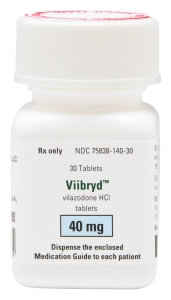
This new one is vilazodone, made by Massachusetts-based company Clinical Data, Inc., and will be sold under the name Viibryd (which I have absolutely no idea how to pronounce, but I’m sure someone will tell me soon).

At first glance, vilazodone seems promising. It’s not exactly a “me-too” drug, a molecule similar in structure and function to something that already exists. Instead, it’s a “dual-action” antidepressant, a selective serotonin reuptake inhibitor and partial agonist at serotonin 1A receptors. In other words, it does two things: it blocks the reuptake of serotonin into neurons (much like the existing SSRIs like Prozac, Zoloft, and Lexapro) and it acts as a partial agonist at a particular type of serotonin receptor called “1A.” A partial agonist is a molecule that binds to a receptor on a target cell and does not activate that cell fully but doesn’t entirely prevent its response, either.

(Note: don’t let the name fool you. “Dual-action” agents are not “twice as effective” as other agents, and sometimes work just the same.)

If you buy the serotonin hypothesis of depression (closely derived from the “monoamine hypothesis“), then depression is caused by a deficiency in serotonin. SSRIs cause an increase in serotonin between two cells. However, the higher levels of serotonin serve as “negative feedback” to the first-order cell in order to keep the system in balance. (Our bodies do this all the time. If I keep yelling at you for no clear reason, you’ll rapidly “downregulate” your attention so that you don’t listen to me anymore. Neurons work this way, too.) The idea behind a partial agonist is that it will only do “part” of the work that serotonin will do (actually, it will effectively block the negative feedback of serotonin) to increase serotonin release even more.

Remember– that’s only if you agree that low serotonin is responsible for depression. And there are plenty of respectable people who just don’t buy this. After all, no one has convincingly shown a serotonin deficit in depression, and when SSRIs do work (which they do, remarkably well sometimes), they may be acting by a totally different mechanism we just don’t understand yet. Nevertheless, vilazodone did show a significant effect as early as the first week, an effect that lasted for eight weeks.

Specifically, a phase III trial of 410 adults with depression showed decreases in MADRS and HAM-D scales relative to placebo, as well as on the CGI-I, CGI-S, and HAM-A scales, with a decrease in MADRS score from a mean of 30.8 at baseline to about 18 at the 8-week timepoint (the placebo group showed a decrease of about 10 points). A similar decrease was seen in the HAM-D. As is typical with these studies, the phase III trial did not compare vilazodone to an existing drug. However, unpublished phase II trials did compare it to fluoxetine (Prozac) and citalopram (Celexa), and to placebo, and results show that the drugs were comparable (and placebo response rates were high, as high as 40% in some trials). Incidentally, 9.3% of patients in the phase III trial dropped out due to adverse effects, mainly diarrhea.

So is a blockbuster in the works? Well, it’s not quite as “new” as one would think. SSRIs have been in widespread use for years, and there’s already a serotonin 1A partial agonist available called BuSpar (generic = buspirone) which is sort of a “ho-hum” drug– effective for some, but nothing to get too excited about. It seems that one could make “homemade” vilazodone by combining buspirone with an SSRI. (Kids, don’t try this at home. Please consult an expert.) This is a fairly common combination, although most psychiatrists have been underwhelmed by buspirone’s efficacy (one of my teachers called it “holy water”). Maybe vilazodone will convince me otherwise.

To go back to my original question, do we really need this? My gut reaction is no, as it seems too similar to what we already have available. There may be a small group of treatment-resistant depressed patients for whom vilazodone will be a wonder drug, a true lifesaver. In an attempt to discover this small group, the manufacturer is simultaneously studying “biomarkers that may predict treatment response.” In other words, they’re looking for genetic “fingerprints” that might predict patients who will respond to their drug (or who will get side effects). They have no “hits” yet (one of the markers they studied in phase III proved to have no predictive value in a follow-up trial), but it’s appealing to think that we might get more data on how to use– or avoid– this new drug more wisely.

While it’s good to have more tools in our toolkit, I sincerely hope this doesn’t turn into yet another in a long line of medications that we give to depressed patients in the trial-and-error process that unfortunately characterizes a lot of depression management. What’s truly needed is not just another serotonin agent, but a guideline (like a genetic test) to predict who’s likely to respond, or, better yet, a more sophisticated understanding of what’s happening in the minds of “depressed” patients. (And the differences among depressed patients far outweigh their similarities.) Until then, we’ll just be making incremental progress toward an elusive goal.