The Perils of Checklist Psychiatry

March 16, 2011

It’s no secret that doctors in all specialties spend less and less time with patients these days.  Last Sunday’s NY Times cover article (which I wrote about here and here) gave a fairly stark example of how reimbursement incentives have given modern psychiatry a sort of assembly-line mentality:  “Come in, state your problems, and here’s your script.  Next in line!!”  Unfortunately, all the trappings of modern medicine—shrinking reimbursements, electronic medical record systems which favor checklists over narratives, and patients who frequently want a “quick fix”—contribute directly to this sort of practice.

To be fair, there are many psychiatrists who don’t work this way.  But this usually comes with a higher price tag, which insurance companies often refuse to pay.  Why?  Well, to use the common yet frustrating phrase, it’s not “evidence-based medicine.”  As it turns out, the only available evidence is for the measurement of specific symptoms (measured by a checklist) and the prescription of pills over (short) periods of time.  Paradoxically, psychiatry—which should know better—no longer sees patients as people with interesting backgrounds and multiple ongoing social and psychological dynamics, but as collections of symptoms (anywhere in the world!) which respond to drugs.

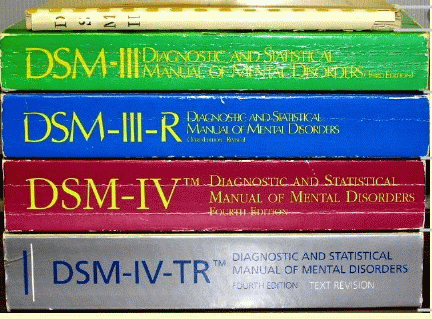
The embodiment of this mentality, of course, is the DSM-IV, the “diagnostic manual” of psychiatry, which is basically a collection of symptom checklists designed to make a psychiatric diagnosis.  Now, I know that’s a gross oversimplification, and I’m also aware that sophisticated interviewing skills can help to determine the difference between a minor disturbance in a patient’s mood or behavior and a pathological condition (i.e., betwen a symptom and a syndrome).  But often the time, or those skills, simply aren’t available, and a diagnosis is made on the basis of what’s on the list.  As a result, psychiatric diagnoses have become “diagnoses of inclusion”:  you say you have a symptom, you’ll get a diagnosis.

To make matters worse, the checklist mentality, aided by the Internet, has spawned a small industry of “diagnostic tools,” freely available to clinicians and to patients, and published in books, magazines, and web sites.  (The bestselling book The Checklist Manifesto may have contributed, too.  In it, author-surgeon Atul Gawande explains how simple checklists are useful in complex situations in which lives are on the line.  He has received much praise, but the checklists he describes help to narrow our focus, when in psychiatry it should be broadened.  In other words, checklists are great for preparing an OR for surgery, or a jetliner for takeoff, but not in identifying the underlying causes of an individual’s suffering.)

Anyway, a quick Google search for any mental health condition (or even a personality trait like shyness, irritability, or anger) will reveal dozens of free questionnaires, surveys, and checklists designed to make a tentative diagnosis.  Most give the disclaimer “this is not meant to be a diagnostic tool—please consult your physician.”

But why?  If the patient has already answered all the questions that the doctor will ask anyway in the 10 to 15 minutes allotted for their appointment, why can’t the patient just email the questionnaire directly to a doc in another state (or another country) from the convenience of their own home, enter their credit card information, and wait for a prescription in the mail?  Heck, why not eliminate the middleman and submit the questionnaire directly to the drug company for a supply of pills?

I realize I’m exaggerating here.  Questionnaires and checklists can be extremely helpful—when used responsibly—as a way to obtain a “snapshot” of a patient’s progress or of his/her active symptoms, and to suggest topics for discussion in a more thorough interview.  Also, people also have an innate desire to know how they “score” on some measure—the exercise can even be entertaining—and their results can sometimes reveal things they didn’t know about themselves.

But what makes psychiatry and psychology fascinating is the discovery of alternate, more parsimonious (or potentially more serious) explanations for a patient’s traits and behaviors; or, conversely, informing a patient that his or her “high score” is actually nothing to be worried about.  That’s where the expert comes in.  Unfortunately, experts can behave like Internet surveys, too, and when we do, the “rush to judgment” can be shortsighted, unfair, and wrong.


What Psychiatrists Treat and Why

February 20, 2011

Do we treat diseases or symptoms in psychiatry?  While this question might sound philosophical in nature, it’s actually a very practical one in terms of treatment strategies we espouse, medications and other interventions we employ, and, of course, how we pay for mental health care.  It’s also a question that lies at the heart of what psychiatry is all about.

Anyone who has been to medical school or who has watched an episode of House knows that a disease has (a) an underlying pathology, often hidden to the naked eye but which is shared by all patients with that diagnosis, and (b) signs and symptoms, which are readily apparent upon exam but which may differ in subtle ways from patient to patient.  An expert physician performing a comprehensive examination can often make a diagnosis simply on the basis of signs and symptoms.  In some cases, more sophisticated tools (lab tests, scans, etc) are required to confirm the diagnosis.  In the end, once a diagnosis is obtained, treatment can commence.

(To be sure, sometimes a diagnosis is not apparent, and a provisional or “rule-out” diagnosis is given.  The doctor may initiate treatment on an empiric basis but will refine the diagnosis on the basis of future observations, responses to treatment, and/or disease course.)

In psychiatry, which is recognized as a branch of medicine and (should) subscribe to the same principles of diagnosis and treatment, the expectations are the same.  There are a number of diseases (or disorders) listed in the DSM-IV, each theoretically with its own underlying pathology and natural history, and each recognizable by a set of signs and symptoms.  A careful psychiatric evaluation and mental status exam will reveal the true diagnosis and suggest a treatment plan to the clinician.

It sounds simple, but it doesn’t always work out this way.  Psychiatrists may disagree about a given diagnosis, or make diagnoses based on “soft” signs.  Moreover, there are very few biological or biochemical tests to “rule in” a psychiatric diagnosis.  As a result, treatment plans for psychiatric patients often include multiple approaches that don’t make sense;  for example, using an antidepressant to treat bipolar disorder, or using antipsychotics to treat anxiety or insomnia symptoms in major depression.

The psychiatrist Nassir Ghaemi at Tufts has written about this before (click here for a very accessible version of his argument and here [registration required] for a more recent dialogue in which he argues his point further).  Ghaemi argues in favor of what he calls “Hippocratic psychopharmacology.” Specifically, we should understand and respect the normal course of a disease before initiating treatment.  He also emphasizes that we not treat symptoms, but rather the disease (this is also known as Osler’s Rule, in honor of Sir William Osler, the “founder of modern medicine”).  For example, Ghaemi makes a fairly compelling argument that bipolar disorder should be treated with a mood stabilizer alone, and not with an antidepressant, or an antipsychotic, or a sedative, because those drugs treat symptoms which should resolve as a person goes through the natural course of the disease.  In other words, we miss the diagnostic forest by focusing on the symptomatic trees.

The problem is, this is a compelling argument only if there is such a diagnosis as “bipolar disorder.”  Or, to be more specific, a clear, unitary entity with a distinct pathophysiological basis that gives rise to the symptoms that we see as mania and depression, and which all “bipolar” patients share.  And I don’t believe this assumption has been borne out.

My personal bias is that bipolar disorder does exist.  So do major depression, schizophrenia, panic disorder, anorexia nervosa, ADHD, and (almost) all the other diagnoses listed in the DSM-IV.  And a deeper understanding of the pathophysiology of each might help us to develop targeted treatments that will be far more effective than what have now.  But we’re not there yet.  In the case of bipolar disorder, lithium is a very effective drug, but it doesn’t work in everyone with “bipolar.”  Why not?  Perhaps “bipolar disorder” is actually several different disorders.  Not just formes frustes of the same condition but separate entities altogether, with entirely different pathophysiologies which might appear roughly the same on the outside (sort of like obesity or alcoholism).  Of course, there are also many diagnosed with “bipolar” who might really have no pathology at all– so it is no surprise that they don’t respond to a mood stabilizer (I won’t elaborate on this possibility here, maybe some other time).

The committee in charge of writing the DSM-5 is almost certainly facing this conundrum.  One of the “holy grails” of 21st century psychiatry (which I wrote about here) is to identify biochemical or genetic markers that predict or diagnose psychiatric disease, and it was hoped that the next version of the DSM would include these markers amongst its diagnostic criteria.   Unfortunately, this isn’t happening, at least not with DSM-5.  In fact, what we’re likely to get is a reshuffling and expansion of diagnostic criteria.  Which just makes matters worse:  how can we follow Osler’s advice to treat the disease and not the symptom when the definition of disease will change with the publication of a new handbook?

As a practicing psychiatrist, I’d love to be able to make a sound and accurate diagnosis and to use this diagnosis to inform my treatment, practicing in the true Hippocratic tradition and following Osler’s Rule, which has benefited my colleagues in other fields of medicine.  I also recognize that this approach would respect Dr Ghaemi’s attempt at bringing some order and sensibility to psychiatric practice.  Unfortunately, this is hard to do because (a) we still don’t know the underlying cause(s) of psychiatric disorders, and (b) restricting myself to pathophysiology and diagnosis means ignoring the psychosocial and environmental factors that are (in many ways) even more important to patients than what “disease” they have.

It has frequently been said that medicine is an art, not a science, and psychiatry is probably the best example of this truism.  Let’s not stop searching for the biological basis of mental illness, but also be aware that it may not be easy to find.  Until then, whether we treat “diagnoses” or “symptoms” is a matter of style.  Yes, the insurance company wants a diagnosis in order to provide reimbursement, but the patient wants management of his or her symptoms in order to live a more satisfying life.


Psychosomatic illness and the DSM-5

January 21, 2011

Among the most fascinating diagnoses in psychiatry are the somatoform disorders; these are characterized chiefly by physical symptoms without a clear medical or biological basis, but which instead are thought to arise from some deeper psychological source.  The field of “psychosomatic medicine” (not to mention many of the most classic cases of in the history of psychiatry and psychoanalysis) illustrates the impact of mental factors on physical illness.  Indeed, most of us have experienced the effects of our moods, thoughts, and attitudes on physical symptoms.  For instance, our headaches intensify when we’re under a lot of stress at work, whereas we can usually ignore pain and fatigue when in the midst of intense and exhilarating competition.  Conversely, intense psychological trauma or prolonged deprivation can contribute to chronic physical disease, while a terminal illness can cause extreme psycholgical suffering.

The somatoform disorders as currently listed in the DSM-IV, the “Bible” of psychiatric diagnosis, are:

  • conversion disorder – unexplained neurological symptoms that are thought to arise in response to psychological conflicts
  • somatization disorder – more widespread physical symptoms (pain, gastrointestinal, sexual, neurological) before the age of 30 and with a chronic course
  • hypochondriasis – excessive preoccupation, worry, or fear about having a serious medical illness
  • body dysmorphic disorder – excessive concern and preoccupation with a perceived (but often nonexistent) physical defect
  • pain disorder – chronic pain in one or more areas, usually exacerbated by psychological factors
  • undifferentiated somatoform disorder – one unexplained physical symptom, present for six months

The planning committee in charge of writing the DSM-5, the replacement to the DSM-IV, wants to scrap this category and create a new one called simply “Somatic Symptom Disorders.”  What makes a “Somatic Symptom Disorder” in the new classification?  According to the APA, “any somatic symptom or concern that is associated with significant distress or dysfunction,” combined with “anxiety” or “persistent concerns” about the symptoms.  Have a nasty, persistent cough?  Frequent headaches?  Concerned about it?  Congratulations, you may now have a mental illness as well.  They also propose a “complex somatic symptom disorder” (CSSD) category in which the symptom(s) is/are accompanied by “excessive or maladaptive response” to those symptoms.  What’s excessive or maladaptive?  As with anything in psychiatry, that’s for you (or, more accurately, your doctor) to decide.

(Specifically, most of the somatoform disorders will be lumped together into the “SSD” category.  They plan to move body dysmorphic disorder into the anxiety group, and the criteria for conversion disorder will be narrowed to describe simply an unexplained neurological symptom– none of the deeper psychological components are necessary for this diagnosis either).

Why would they do such a thing?  In the words of the APA, “clinicians find these diagnoses unclear” and “patients find them very objectionable.”  In other words, doctors just don’t use these diagnoses, and patients think their concerns aren’t being taken seriously.

Whether this justification seems appropriate is certainly debatable.  Maybe these diagnoses aren’t made because we’re just not looking for them.  Maybe we’re afraid of alienating patients.  Maybe it’s because no new drugs have been approved for use in somatoform disorders.  Or maybe it really is just a bogus category.  Nonetheless, the proposed solution may be just as bogus.  Indeed, it seems rather absurd to give a psychiatric diagnosis on the basis of a single unexplained bodily symptom and, of course, one complaint about this proposal is that it continues psychiatry’s gradual march towards pathologizing everyone.

To me, the greatest disappointment is that the richness and complexity of the various somatoform disorders will be disposed of, in favor of criteria that only require a physical symptom and “anxiety or concern” about the symptom.  It may sound condescending or objectionable to remark that an unexplained symptom is “all in one’s head,” but these more user-friendly diagnostic criteria may make clinicians even less likely to “look under the hood,” so to speak, and to uncover the mental and psychological factors that may have an overwhelming, yet hidden, influence on the patient’s body and his/her perceptions of bodily phenomena.
 
We are only beginning to understand the intricacies and wonders of the connections between mind and body.  Such understanding draws heavily on complementary approaches to human health and disease, alongside the findings of conventional medical science.  Hopefully, psychiatric practitioners will continue to pay attention to advances in this field in order to provide comprehensive, “holistic” care to patients, even if the DSM-5’s efforts at diagnostic expediency and simplicity portend otherwise.


Bipolar in the eye of the beholder

January 4, 2011


So whom is the joke on here?

I found this video on one of the several blogs I subscribe to.
(Okay, I’ll admit it, I’m a sucker for these Xtranormal videos.)

It seems to be composed from the point of view of the jaded psychiatric consumer patient, disturbed at the fact that her fairly unremarkable complaints are interpreted by her psychiatrist as symptoms of bipolar disorder, and how every problem’s solution seems to be a medication adjustment.

Indeed, most mental health conditions include, among their symptoms, common concerns like insomnia, poor attention/concentration, feelings of sadness, or (my personal favorite) “stress.”  But the truth is that bipolar disorder (the topic of this video) is a serious illness which can, at times, be incapacitating and threaten one’s livelihood or even one’s life.  Sleeplessness and “talking fast,” in and of themselves, do not make a bipolar diagnosis.

Watching the video as a psychiatrist, however, I’m reminded of the other side of the issue; namely, that patients will frequently come in with fairly ordinary complaints and profess that they must be “bipolar” or “depressed” or “anxious” and require medication.  Sometimes this self-assessment is accurate, but other times it’s more appropriate to exercise restraint.

The truth remains that, while in some physician-patient encounters the doctor tries to diagnose and treat on the basis of few symptoms, at other times the patient actually wants the diagnosis and/or the drug.  Which gives rise to the age-old
“slippery slope” in psychiatry, in which we deal with behaviors existing on a spectrum from normal to pathological.  Where does “wellness” end and “illness” begin?  And who makes this decision?


Allen Frances and the DSM-5

December 30, 2010

There’s a great (and long) article in the January 2011 Wired magazine profiling Allen Frances, lead editor of the DSM-IV and an outspoken critic of the process by which the American Psychiatric Association (APA) is developing the next version, the DSM-5.  It’s worth a read and can be found here, as it provides a revealing look at a process that, according to the author (somewhat melodramatically, I might add) could make or break modern psychiatry.

I have many feelings about what’s written in the article, but one passage in particular caught my attention.  The author, Gary Greenberg, writes that he asked a psychiatrist (in fact, a “former president of the APA”) how he uses the DSM in his daily work.

He told me his secretary had just asked him for a diagnosis on a patient he’d been seeing for a couple of months so that she could bill the insurance company. “I hadn’t really formulated it,” he told me.  He consulted the DSM-IV and concluded that the patient had obsessive-compulsive disorder (OCD). 

“Did it change the way you treated her?” I asked, noting that he’d worked with her for quite a while without naming what she had.

“No.”

“So what would you say was the value of the diagnosis?”

“I got paid.”

I include this excerpt because the “hook” here—and the part that will most likely attract the most fervent anti-psychiatry folk—is the line about “getting paid.”  But this entirely misses the point.

See, the DSM-5 is easy to criticize because it seems like a catalogue of invented “syndromes”, from which any psychiatrist can pick out a few symptoms (some of which, I would venture to say, both you and I are experiencing right now), name a diagnosis, and prescribe a medication—and get paid by the insurance company because he believes he is confidently treating a “disease.”  But the truth of the matter, if you talk to any thoughtful psychiatrist, is that, more often than not, the book gets in the way.

In the example above, the doctor had seen his patient for several sessions but hadn’t yet come up with a firm diagnosis.  He settled upon OCD because he was required to write a diagnosis on some form or another.  Yes, ultimately to get paid, but I think we’d all agree that professionals deserve to be reimbursed for their time.  (And if he’s actually listening to his patient instead of comparing her symptoms to a list in a book, his patient would probably agree as well.)

Did this woman have OCD?  Judging by his hesitancy, it’s arguable that perhaps she didn’t have all of the symptoms of OCD.  But she was probably suffering nonetheless, and such presentations are typical of most psychiatric patients.  Nobody fits the DSM mold, we all have quirks and characteristics that present a very complicated picture.  I would argue that this psychiatrist was probably doing well by not rushing to a diagnosis, but instead getting to learn about this woman and develop a treatment plan that was most appropriate for her.

The article’s author writes that if the DSM-5 is a “disaster,” as some observers predict it will be, the APA will “lose its franchise on our psychic suffering, the naming rights to our pain.”  Quite frankly, this could turn out to be the best possible outcome for patients.  If we as a profession ditch the DSM, and stop looking at patients through the lens of ill-defined lists of symptoms, but instead see them as actual individuals, we can better alleviate their suffering.  Yes, a new system will need to be devised to ensure that we can prescribe the interventions that we believe are most appropriate (and yes, to get paid for them), but a patient-centered approach is preferable to a formula-based approach anytime.


Are we more depressed?

December 21, 2010

A new study in the Archives of General Psychiatry examines trends in the treatment of depression between 1998 and 2007, and finds that—surprise, surprise!—we’re treating more depression.

The study finds that the rate of outpatient treatment for depression increased from 2.37 per 100 persons in 1998 to 2.88 per 100 persons in 2007.  That is, almost three of every 100 persons reported that they sought some sort of treatment for depression.

Some other findings from the study:

1998 2007
Percentage of depressed patients on antidepressants 73.8% 75.3%
Percentage of depressed patients who received psychotherapy 54% 43%
National expenditures for outpatient treatment of depression $10.05 B $12.45 B
Cost attributed to medications $4.59 B $6.60 B

(1998 numbers adjusted for inflation)

So what does this all mean?  Well, for starters, here’s how the study was done:  about 23,000 individuals were interviewed about their treatment over the past year.  If patients reported seeking help for “depression,” they were included, even though they may have been suffering from dysthymia, a depressed phase of bipolar disorder, an adjustment disorder, or an underlying anxiety or substance use problem.  Regarding the expenditures, these numbers were gathered from large databases of office visits and hospitalizations, and data were included only if the providers gave a diagnosis of major depression, dysthymia, or “depression not otherwise specified.”

Note the rise in medication costs, up to $6.6 billion in 2007.  (Of this, the proportion borne by Medicare rose from $0.5 to $2.25 billion, most likely due to the implementation of Medicare Part D in 2006.)  These numbers reflect a substantial increase in how much money we’re paying for antidepressants and other medications to treat depresssion.  (In case you were wondering, the total outlay for the entire Medicare program in 2007 was $375 billion.)

So we’re spending more money on depression treatment, and more than half of that money is on medications for depression.  (Incidentally, the same researchers also reported that the percentage of all Americans taking antidepressants in any given year rose from 5% to 10% over the same time period.)  Does that mean we’re winning the war on depression?  Doesn’t look like it.  Does it mean people are more depressed now than they were in the past?  Possibly.  Is there some other reason why patients are seeking help, and providers just find it more palatable to give a diagnosis of depression?  That’s a possibility, too.

All I can say is, when I see numbers rising like this—whether we’re talking about disease rates, costs, or numbers of prescriptions—it means we’re not handling this epidemic very well.  The question is, epidemic of what, exactly?


The future of psychiatric diagnosis?

December 20, 2010

What is a mental illness?  To most psychiatrists, the answer lies in the DSM-IV, essentially a catalog of diagnoses and diagnostic features of each disorder.  It has been derided as presenting a “cookbook” (or, perhaps less PC, a “Chinese menu”) approach to psychiatry, in which a diagnosis is made on the basis of the presence of a number of symptoms drawn from a list.

While this approach has proven helpful for research and clinical purposes, it unfortunately oversimplifies what is undoubtedly an extraordinarily rich spectrum of mental disorders.  (It also, of course, calls into question where is the demarcation between “normal” and “disorder” on that spectrum, but more about that some other time.)  As any clinician will tell you, no two depressed patients are alike, just as no two schizophrenics are alike, no two bipolar patients are alike, and so forth.

In reality, there may be dozens of diseases that we now call “scihzophrenia” (or “depression” or “panic disorder,” etc).  Some may stem from a clear genetic mutation in some as-yet unidentified gene, while others may be a consequence of endocrine dysregulation or disturbances in brain development.  Others may be defined by their propensity to respond (or not) to various pharmaceutical agents, or the patient’s biological tendency to endure side effects of such agents such as weight gain or movement disorders.

The National Institute of Mental health (NIMH) is trying to expand our nosologic system by incorporating neurobiolgoical and physiological measures as well as observable behavior in our classification of psychiatric disorders.  The Research Domain Criteria aims to

… define basic dimensions of functioning (such as fear circuitry or working memory) … across multiple levels of analysis, from genes to neural circuits to behaviors, cutting across disorders as traditionally defined.

What might this mean for the future of psychiatry?  For starters, instead of a checklist to generate a diagnosis, a clinician might order a brain scan, a blood test, a measure of some genetic marker, or a more intensive review of one’s history in order to develop an “individualized” treatment approach.  How long it takes to get to this point (and whether we can afford it) remains to be seen.