Psychopharm R&D Cutbacks II: A Response to Stahl

August 28, 2011

A lively discussion has emerged on the NEI Global blog and on Daniel Carlat’s psychiatry blog about a recent post by Stephen Stahl, NEI chairman, pop(ular) psychiatrist, and promoter of psychopharmaceuticals.  The post pertains to the exodus of pharmaceutical companies from neuroscience research (something I’ve blogged about too), and the changing face of psychiatry in the process.

Dr Stahl’s post is subtitled “Be Careful What You Ask For… You Just Might Get It” and, as one might imagine, it reads as a scathing (some might say “ranting”) reaction against several of psychiatry’s detractors: the “anti-psychiatry” crowd, the recent rules restricting pharmaceutical marketing to doctors, and those who complain about Big Pharma funding medical education.  He singles out Dr Carlat, in particular, as an antipsychiatrist, implying that Carlat believes mental illnesses are inventions of the drug industry, medications are “diabolical,” and drugs exist solely to enrich pharmaceutical companies.  [Not quite Carlat’s point of view, as  a careful reading of his book, his psychopharmacology newsletter, and, yes, his blog, would prove.]

While I do not profess to have the credentials of Stahl or Carlat, I have expressed my own opinions on this matter in my blog, and wanted to enter my opinion on the NEI post.

With respect to Dr Stahl (and I do respect him immensely), I think he must re-evaluate his influence on our profession.  It is huge, and not always in a productive way.  Case in point: for the last two months I have worked in a teaching hospital, and I can say that Stahl is seen as something of a psychiatry “god.”  He has an enormous wealth of knowledge, his writing is clear and persuasive, and the materials produced by NEI present difficult concepts in a clear way.  Stahl’s books are directly quoted—unflinchingly—by students, residents, and faculty.

But there’s the rub.  Stahl has done such a good job of presenting his (i.e., the psychopharmacology industry’s) view of things that it is rarely challenged or questioned.  The “pathways” he suggests for depression, anxiety, psychosis, cognition, insomnia, obsessions, drug addiction, medication side effects—basically everything we treat in psychiatry—are accompanied by theoretical models for how some new pharmacological agent might (or will) affect these pathways, when in fact the underlying premises or the proposed drug mechanisms—or both—may be entirely wrong.  (BTW, this is not a criticism of Stahl, this is simply a statement of fact; psychiatry as a neuroscience is decidedly still in its infancy.)

When you combine Stahl’s talent with his extensive relationships with drug companies, it makes for a potentially dangerous combination.  To cite just two examples, Stahl has written articles (in widely distributed “throwaway” journals) making compelling arguments for the use of low-dose doxepin (Silenor) and L-methylfolate (Deplin) in insomnia and depression, respectively, when the actual data suggest that their generic (or OTC) equivalents are just as effective.  Many similar Stahl productions are included as references or handouts in drug companies’ promotional materials or websites.

How can this be “dangerous”?  Isn’t Stahl just making hypotheses and letting doctors decide what to do with them?  Well, not really.  In my experience, if Stahl says something, it’s no longer a hypothesis, it becomes the truth.

I can’t tell you how many times a student (or even a professor of mine) has explained to me “Well, Stahl says drug A works this way, so it will probably work for symptom B in patient C.”  Unfortunately, we don’t have the follow-up discussion when drug A doesn’t treat symptom B; or patient C experiences some unexpected side effect (which was not predicted by Stahl’s model); or the patient improves in some way potentially unrelated to the medication.  And when we don’t get the outcome we want, we invoke yet another Stahl pathway to explain it, or to justify the addition of another agent.  And so on and so on, until something “works.”  Hey, a broken clock is still correct twice a day.

I don’t begrudge Stahl for writing his articles and books; they’re very well written, and the colorful pictures are fun to look at– it makes psychiatry almost as easy as painting by numbers.  I also (unlike Carlat) don’t get annoyed when doctors do speaking gigs to promote new drugs.  (When these paid speakers are also responsible for teaching students in an academic setting, however, that’s another issue.)  Furthermore, I accept the fact that drug companies will try to increase their profits by expanding market share and promoting their drugs aggressively to me (after all, they’re companies—what do we expect them to do??), or by showing “good will” by underwriting CME, as long as it’s independently confirmed to be without bias.
The problem, however, is that doctors often don’t ask for the data.  We don’t  ask whether Steve Stahl’s models might be wrong (or biased).  We don’t look closely at what we’re presented (either in a CME lesson or by a drug rep) to see whether it’s free from commercial influence.  And, perhaps most distressingly, we don’t listen enough to our patients to determine whether our medications actually do what Stahl tells us they’ll do.

Furthermore, our ignorance is reinforced by a diagnostic tool (the DSM) which requires us to pigeonhole patients into a small number of diagnoses that may have no biological validity; a reimbursement system that encourages a knee-jerk treatment (usually a drug) for each such diagnosis; an FDA approval process that gives the illusion that diagnoses are homogeneous and that all patients will respond the same way; and only the most basic understanding of what causes mental illness.  It creates the perfect opportunity for an authority like Stahl to come in and tell us what we need to know.  (No wonder he’s a consultant for so many pharmaceutical companies.)
As Stahl writes, the departure of Big Pharma from neuroscience research is unfortunate, as our existing medications are FAR from perfect (despite Stahl’s texts making them sound pretty darn effective).  However, this “breather” might allow us to pay more attention to our patients and think about what else—besides drugs—we can use to nurse them back to health.  Moreover, refocusing our research efforts on the underlying psychology and biology of mental illness (i.e., research untainted by the need to show a clinical drug response or to get FDA approval) might open new avenues for future drug development.

Stahl might be right that the anti-pharma pendulum has swung too far, but that doesn’t mean we can’t use this opportunity to make great strides forward in patient care.  The paychecks of some docs might suffer.  Hopefully our patients won’t.


Big Brother in Your Medicine Cabinet

June 29, 2011

If there’s one thing I’ve learned from working as a doctor, it is that “what the doctor ordered” is not always what the patient gets.  Sure, I’ve encountered the usual obstacles—like pharmacy “benefit” (ha!) managers whose restrictive formularies don’t cover the medications ordered by their physicians—but I’ve also been amazed by the number of patients who don’t take medications as prescribed.  In psychiatry, the reasons are numerous:  patients may take their SSRI “only when I feel depressed,” they double their dose of a benzodiazepine “because I like the way it makes me feel,” they stop taking two or three of their six medications out of sheer confusion, or they take a medication for entirely different purposes than those for which it was originally prescribed.  (If I had a nickel for every patient who takes Seroquel “to help me sleep,” I’d be a very rich man.)

In the interest of full disclosure, this is not limited to my patients.  Even in my own life, I found it hard to take my antidepressant daily (it really wasn’t doing anything for me, and I was involved in other forms of treatment and lifestyle change that made a much bigger difference).  And after a tooth infection last summer, it was a real challenge to take my penicillin three times a day.  I should know better.  Didn’t I learn about this in med school??

This phenomenon used to be called “noncompliance,” a term which has been replaced by the more agreeable term, “nonadherence.”  It’s rampant.  It is estimated to cost the US health care system hundreds of billions of dollars annually.  But how serious is it to human health?  The medical community—with the full support of Big Pharma, mind you—wants you to believe that it is very serious indeed.  In fact, as the New York Times reported last week, we now have a way to calculate a “risk score” for patients who are likely to skip their medications.  Developed by the FICO company, the “Medication Adherence Score” can predict “which patients are at highest risk for skipping or incorrectly using” their medications.

FICO?  Where have you heard of them before?  Yes, that’s right, they’re the company who developed the credit score:  that three-digit number which determines whether you’re worthy of getting a credit card, a car loan, or a home mortgage.  And now they’re using their clout and influence actuarial skills to tell whether you’re likely to take your meds correctly.

To be sure, some medications are important to take regularly, such as antiretrovirals for HIV, anticoagulants, antiarrhythmics, etc, because of the risk of severe consequences after missed doses.  As a doctor, I entered this profession to improve lives—and oftentimes medications are the best way for my patients to thrive.  [Ugh, I just can’t use that word anymore… Kaiser Permanente has ruined it for me.]

But let’s consider psychiatry, shall we?  Is a patient going to suffer by skipping Prozac or Neurontin for a few days?  Or giving them up altogether to see an acupuncturist instead?  That’s debatable.

Anyway, FICO describes their score as a way to identify patients who would “benefit from follow-up phone calls, letters, and emails to encourage proper use of medication.”  But you can see where this is going, can’t you?  It’s not too much of a stretch to see the score being used to set insurance premiums and access (or lack thereof) to name-brand medications.  Hospitals and clinics might also use it to determine which patients to accept and which to avoid.

Independently (and coincidentally?), the National Consumers League inaugurated a program last month called “Script Your Future,” which asks patients to make “pledges” to do things in the future (like “walk my daughter down the aisle” or “always be there for my best friend”) that require—or so it is implied—adherence to their life-saving medications.  Not surprisingly, funds for the campaign come from a coalition including “health professional groups, chronic disease groups, health insurance plans, pharmaceutical companies, [and] business organizations.”  In other words: people who want you to take drugs.

The take-home message to consumers patients, of course, is that your doctors, drug companies, and insurers care deeply about you and truly believe that adherence to your medication regimen is the key to experiencing the joy of seeing your children graduate from college or retiring to that villa in the Bahamas.  Smile, take our drugs, and be happy.  (And don’t ask questions!)

If a patient doesn’t want to take a drug, that’s the patient’s choice—which, ultimately, must always be respected (even if ends up shortening that patient’s life).  At the same time, it’s the doctor’s responsibility to educate the patient, figure out the reasons for this “nonadherence,” identify the potential dangers, and help the patient find suitable alternatives.  Perhaps there’s a language barrier, a philosophical opposition to drugs, a lack of understanding of the risks and benefits, or an unspoken cultural resistance to Western allopathic medicine.  Each of these has its merits, and needs to be discussed with the patient.

Certainly, if there are no alternatives available, and a patient still insists on ignoring an appropriate and justifiable medical recommendation, we as a society have to address how to hold patients accountable, so as not to incur greater costs to society down the road (I’m reminded here of Anne Fadiman’s excellent book The Spirit Catches You And You Fall Down).  At the same time, though, we might compensate for those increased costs by not overprescribing, overtreating, overpathologizing, and then launching campaigns to make patients complicit in (and responsible for!) these decisions.

Giving patients a “score” to determine whether they’re going to take their meds is the antithesis of good medicine.  Good medicine requires discussion, interaction, understanding, and respect.  Penalizing patients for not following doctors’ orders creates an adversarial relationship that we can do without.


Psychopharm R&D Cutbacks: Crisis or Opportunity?

June 19, 2011

The scientific journal Nature ran an editorial this week with a rather ominous headline: “Psychopharmacology in Crisis.”  What exactly is this “crisis” they speak of?  Is it the fact that our current psychiatric drugs are only marginally effective for many patients?  Is it the fact that they can often cause side effects that some patients complain are worse than the original disease?  No, the “crisis” is that the future of psychopharmacology is in jeopardy, as pharmaceutical companies, university labs, and government funding agencies devote fewer resources to research and development in psychopharmacology.  Whether this represents a true crisis, however, is entirely in the eye of the beholder.

In 2010, the pharmaceutical powerhouses Glaxo SmithKline (GSK) and AstraZeneca closed down R&D units for a variety of CNS disorders, a story that received much attention.  They suspended their research programs because of the high cost of bringing psychiatric drugs to market, the potential for lawsuits related to adverse events, and the heavy regulatory burdens faced by drug companies in the US and Europe.  In response, organizations like the European College of Neuropsychopharmacology (ECNP) and the Institute of Medicine in the US have convened summits to determine how to address this problem.

The “problem,” of course, for pharmaceutical companies is the potential absence of a predictable revenue stream.  Over the last several years, big pharma has found it to be more profitable not to develop novel drugs, but new niches for existing agents—a decision driven by MBAs instead of MDs and PhDs.  As Steve Hyman, NIMH director, told Science magazine last June,  “It’s hardly a rich pipeline.  It suggests a sad dearth of ideas and … lots of attempts at patent extensions and new indications for old drugs.”

Indeed, when I look back at the drug approvals of the last three or four years, there really hasn’t been much to get excited about:  antidepressants (Lexapro, Pristiq, Cymbalta) that are similar in mechanism to other drugs we’ve been using for years; new antipsychotics (Saphris, Fanapt, Latuda) that are essentially me-too drugs which don’t dramatically improve upon older treatments; existing drugs (Abilify, Seroquel XR) that have received new indications for “add-on” treatment; existing drugs (Silenor, Nuedexta, Kapvay) that have been tweaked and reformulated for new indications; and new drugs (Invega, Oleptro, Invega Sustenna) whose major attraction is a fancy, novel delivery system.

Testing and approval of the above compounds undoubtedly cost billions of dollars (investments which, by the way, are being recovered in the form of higher health care costs to you and me), but the benefit to patients as a whole has been only marginal.

The true crisis, in my mind, is that with each new drug we psychiatrists are led to believe that we’re witnessing the birth of a blockbuster.  Not to mention the fact that patients expect the same, especially with the glut of persuasive direct-to-consumer advertising (“Ask your doctor if Pristiq is right for you!”).  Most third-party payers, too, are more willing to pay for medication treatment than anything else (although—thankfully—coverage of newer agents often requires the doctor to justify his or her decision), even though many turn out to be a dud.

In the meantime, this focus on drugs neglects the person behind the illness.  Not every person who walks into my office with a complaint of “depression” is a candidate for Viibryd or Seroquel XR.  Or even a candidate for antidepressants at all.  But the overwhelming bias is that another drug trial might work.  “Who knows—maybe the next drug is the ‘right’ one for this patient!”

Recently, I’ve joked with colleagues that I’d like to see a moratorium on psychiatric drug development.  Not because our current medications meet all of our needs, or that we can get by without any further research.  Not at all.  But if we had, say, five years with NO new drugs, we might be able to catch our collective breaths, figure out exactly what we’re treating after all (maybe even have a more fruitful and unbiased discussion about what to put in the new DSM-5), and, perhaps, devote resources to nonpharmacological treatments, without getting caught up in the ongoing psychopharmacology arms race that, for many patients, focuses our attention where it doesn’t belong.

So it looks like my wish might come true.  Maybe we can use the upcoming slowdown to determine where the real needs are in psychiatry.  Maybe if we devote resources to community mental health services, to drug and alcohol treatment, pay more attention to our patients’ personality traits, lifestyle issues, co-occurring medical illnesses, and respond to their goals for treatment rather than AstraZeneca’s or Pfizer’s, we can improve the care we provide and figure out where new drugs might truly pay off.  Along the way, we can spend some time following the guidelines discussed in a recent report in the Archives of Internal Medicine, and practice “conservative prescribing”—i.e., making sensible decisions about what we prescribe and why.

Sometimes, it is true that less is more.  When Big Pharma backs out of drug development, it’s not necessarily a bad thing.  In fact, it may be precisely what the doctor ordered.


Lexapro, Hot Flashes, and Doing What Works

June 15, 2011

One of the most common—and distressing—symptoms of menopause is the “hot flash.”  As many as 85% of perimenopausal women complain of hot flashes, characterized by a sensation of intense heat, a flushed appearance, perspiration, and pressure in the head.  An effective remedy for hot flashes over the years has been hormone replacement therapy, but many women shun this treatment because of the increased risk of breast cancer, heart disease, and stroke.  In its place, antidepressants like SSRIs and SNRIs have become more commonly prescribed for hot flashes.  Many women report great improvement in symptoms, both anecdotally and in some small open-label trials, with antidepressant therapy.

But do antidepressants actually do anything at all?

Jim Edwards covers this story in a post today on bnet’s “Placebo Effect” blog. Edwards describes a study published in the Journal of the American Medical Association (JAMA) in January 2011 (PDF here).  The study showed the clear benefit of Lexapro (an SSRI made by Forest Labs) relative to placebo in a randomized clinical trial of more than 200 menopausal women with hot flashes.  However, Edwards also reports that a brand new study (which he calls “elegant”) published in the journal Menopause found NO effect of Lexapro.  This second study measured hot flashes not by patient report, but instead by a “battery-powered hot flash detector” worn by women participating in the research.

Does Edwards conclude that the first study was bogus?  Well, not quite.  Edwards argues that the integrity of the JAMA study was dubious from the start because its lead author, Ellen Freeman, received money (honoraria and research support) from Forest Labs, while the paper in Menopause was not tainted by drug company money.  (Note: he neglected to point out that the author of the second study, Robert Freedman, holds a patent, US # 60,741,376, on the “hot flash detector” used in his study.  Yeah, that’s “elegant.”)

Now, I understand that pharmaceutical company funding has a potential to bias research (sometimes a great deal), even when the researchers swear by their objectivity.  But in this case, Edwards’ axe-grinding seems to have obscured some more relevant arguments.  In his zeal to criticize Freeman for her nefarious Forest ties, he ignores the fact that patients often do report a benefit of Lexapro.  A more relevant (and convincing) argument might have been: What makes Lexapro that much better than a generic SSRI—which would be significantly cheaper—in the treatment of hot flashes?  But no, that question was overlooked.

It’s also important to consider the methods used in the Menopause study.  Freedman and his colleagues used “objective” measures of hot flashes (using a device patented by the author, remember) instead of patients’ self-report.  What did these ambulatory monitors measure?  “Humidity on the chest”—that’s it.  (Hmmm… maybe the Exmovere Corporation could build an “Exmobaby garment” for menopausal women??)  Lexapro had no significant effect on this objective measurement.

But the problem is, hot flashes are subjective experiences.  Just like depressed mood, fatigue, pain, gastrointestinal upset, and many other symptoms we treat in medicine.  There’s probably a physiological explanation, but we don’t know what it is.  I’m sorry, but it seems presumptuous (if not downright arrogant) to say that a biometric device is an “accurate” detector of hot flashes, regardless of what the woman reports.  It’s like saying that a person is depressed because his ethanolamine phosphate level is high, or that another has OCD because she has a thicker right superior parietal gyrus in an MRI scan.

Anyway, back to Edwards’ blog post:  His opening sentence, dripping with obvious sarcasm, is “Never mind the evidence; just treat patients’ complaints.”  He then proceeds to completely downplay (if not ridicule) the fact that women frequently report a benefit of Lexapro and other SSRIs.

I wonder whether Edwards has paid any attention to what we’ve been doing in psychiatry for the last several decades.  Trust me, I would love to understand the biological basis of my patients’ symptoms—whether depression, psychosis, anxiety, or hot flashes—in order to develop more “targeted” medical treatment.  But the evidence is just not there (yet?).  In the meantime, we have to use what we’ve got.  If a woman reports improvement on Lexapro without any side effects (in other words, if the benefit exceeds the risk), I’ll prescribe it.

Let me be clear.  I’m not defending Lexapro:  if there’s a cheaper generic alternative available we should use it.  Similarly, I’m not defending Ellen Freeman: pharmaceutical funding should be fully disclosed and, moreover, it does skew what gets published (or not).  And I’m not criticizing Dr Freedman’s Hot Flash Detector (why does that sound like something out of a 1920’s Sears Catalog?): objective measures of subjective complaints help us to understand complicated pathophysiology more clearly.

But if patients benefit from a treatment (and aren’t harmed by it), we owe it to them to provide it.  Arguments like “the research is biased,” “it’s not scientific enough,” or “doctors don’t know how it works anyway” are valid, and should not be ignored, but should also not keep us from prescribing treatments that alleviate our patients’ suffering.


CME, CE, and What Makes A Psychiatrist

May 25, 2011

Why do psychiatrists do what they do?  How— and why— is a psychiatrist different from a psychotherapist?  I believe that most psychiatrists entered this field wanting to understand the many ways to understand and to treat what’s “abnormal,” but have instead become caught up in (or brainwashed by?) the promises of modern-day psychopharmacology.  By doing so, we’ve found ourselves pigeonholed into a role in which we prescribe drugs while others provide the more interesting (and more rewarding) psychosocial interventions.

Exceptions certainly do exist.  But psychiatrists are rapidly narrowing their focus to medication management alone.  If we continue to do so, we’d better be darn sure that what we’re doing actually works.  If it doesn’t, we may be digging ourselves a hole from which it will be difficult—if not impossible—to emerge.

How did we get to this point?  I’m a (relatively) young psychiatrist, so I’ll admit I don’t have the historical perspective of some of my mentors.  But in my brief career, I’ve seen these influences:  training programs that emphasize psychopharmacology over psychotherapy; insurance companies that reimburse for medication visits but not for therapy; patients who demand medications as a quick fix to their problems (and who either can’t access, or don’t want, other therapeutic options); and treatment settings in which an MD is needed to prescribe drugs while the “real work” is done by others.

But there’s yet another factor underlying psychiatry’s increasing separation from other behavioral health disciplines:  Continuing Medical Education, or CME.

All health care professionals must engage in some sort of professional education or “lifelong learning” to maintain their licenses.  Doctors must complete CME credits.  PAs, nurses, psychologists, social workers, and others must also complete their own Continuing Education (CE) credits, and the topics that qualify for credit differ from one discipline to the next.

The pediatrician and blogger Claudia Gold, MD, recently wrote about a program on “Infant-Parent Mental Health,” a three-day workshop she attended, which explored “how early relationships shape the brain and influence healthy emotional development.”  She wrote that the program “left me well qualified to do the work I do,” but she couldn’t receive CME credits because they only offered credit for psychologists—not for doctors.

I had a similar experience several years ago.  During my psychiatry residency, I was invited to attend a “Summit for Clinical Excellence” in Monterey, sponsored by the Ben Franklin Institute.  The BFI offers these symposia several times a year; they’re 3- or 4-day long programs consisting of lectures, discussions, and workshops on advanced mental health topics such as addictions, eating disorders, relationship issues, personality disorders, trauma, ethics, etc.—in other words, areas which fall squarely under the domain of “mental health,” but which psychiatrists often don’t treat (mainly because there are no simple “medication solutions” for many of these problems).

Even though my residency program did not give me any days off for the event (nor did they provide any financial support), I rearranged my schedule and attended anyway.  It turned out to be one of the most memorable events of my training.  I got to meet (yes, literally meet, not just sit in an audience and listen to) influential figures in mental health like Helen Fisher, Harville Hendrix, Daniel Amen, Peter Whybrow, and Bill O’Hanlon.  And because most of my co-attendees were not physicians, the discussions were not about medications, but rather about how we can best work with our patients on a human and personal level.  Indeed, the lessons I learned there (and the professional connections I made) have turned out to be extraordinarily valuable in my everyday work.  (For a link to their upcoming summits, see this link.  Incidentally, I am not affiliated with the BFI in any way.)

Unfortunately, like Dr Gold, I didn’t receive any CME credits for this event either, even though my colleagues in other fields did get credit.  A few days ago, out of curiosity, I contacted BFI and inquired about their CME policy.  I was told that “the topic [of CME] comes up every few years, and we’ve thought about it,” but they’ve decided against it for two reasons.  First, there’s just not enough interest.  (I guess psychiatrists are too busy learning about drugs to take time to learn about people or ideas.)  Second, they said that the application process for CME accreditation is expensive and time-consuming (the application packet “is three inches thick”), and the content would require “expert review,” meaning that it would probably not meet criteria for “medical” CME because of its de-emphasis of medications.

To be fair, any doctor can attend a BFI Summit, just as anyone could have attended Dr Gold’s “Infant-Parent Mental Health” program.  And even though physicians don’t receive CME credits for these programs, there are many other simple (and free, even though much of it is Pharma-supported) ways to obtain CME.

At any rate, it’s important—and not just symbolically—to look at where doctors get their training.  I want to learn about non-pharmacological, “alternative” ways to treat my patients (and to treat patients who don’t fit into the simple DSM categories—which is, well, pretty much everyone).  But to do so, it would have to be on my own dime, and without CME credit.  On the other hand, those who do receive this training (and the credit) are, in my opinion, prepared to provide much better patient care than those of us who think primarily about drugs.

At the risk of launching a “turf war” with my colleagues in other behavioral health disciplines, I make the following proposal: if psychologists lobby for the privilege to prescribe medications (a position which—for the record—I support), then I also believe that psychiatrists should lobby their own professional bodies (and the Accreditation Council for CME [ACCME]) to broaden the scope of what counts as “psychiatric CME.”  Medications are not always the answer.  Similarly, neurobiology and genetics will not necessarily lead us to better therapeutics.  And even if they do, we still have to deal with patients—i.e., human beings—and that’s a skill we’re neither taught nor encouraged to use.  I think it’s time for that to change.


Psychopharmacology And The Educated Guess

May 6, 2011

Sometimes I feel like a hypocrite.

As a practicing psychiatrist, I have an obligation to understand the data supporting my use of prescription medication.  In my attempts to do so, I’ve found some examples of clinical research that, unfortunately, are possibly irrelevant or misleading.  Many other writers and bloggers have taken this field to task (far more aggressively than I have) for clinical data that, in their eyes, are incomplete, inconclusive, or downright fraudulent.

In fact, we all like to hold our clinical researchers to an exceedingly high standard, and we complain indignantly when they don’t achieve it.

At the same time, I’ll admit I don’t always do the same in my own day-to-day practice.  In other words, I demand precision in clinical trials, but several times a day I’ll use anecdotal evidence (or even a “gut feeling”) in my prescribing practices, completely violating the rigor that I expect from the companies that market their drugs to me.

Of all fields in medicine, psychopharmacology the one where this is not only common, but it’s the status quo.

“Evidence-based” practice is about making a sound diagnosis and using published clinical data to make a rational treatment decision.  Unfortunately, subjects in clinical trials of psychotropic drugs rarely—if ever—resemble “real” patients, and the real world often throws us curve balls that force us to improvise.  If an antipsychotic is only partially effective, what do we do?  If a patient doesn’t tolerate his antidepressant, then what?  What if a drug interferes with my patient’s sleep?  Or causes a nasty tremor?  There are no hard-and-fast rules for dealing with these types of situations, and the field of psychopharmacology offers wide latitude in how to handle them.

But then it gets really interesting.  Nearly all psychiatrists have encountered the occasional bizarre symptom, the unexpected physical finding, or the unexplained lab value (if labs are being checked, that is).  Psychopharmacologists like to look at these phenomena and try to concoct an explanation based on what might be happening based on their knowledge of the drugs they prescribe.  In fact, I’ve always thought that the definition of an “expert psychopharmacologist” is someone who understands the properties of drugs well enough to make a plausible (albeit potentially wrong) molecular or neurochemical explanation of a complex human phenotype, and then prescribe a drug to fix it.

The psychiatric literature is filled with case studies of interesting encounters or “clinical pearls” that illustrate this principle at work.

For example, consider this case report in the Journal of Neuropsychiatry and Clinical Neurosciences, in which the authors describe a case of worsening mania during slow upward titration of a Seroquel dose and hypothesize that an intermediate metabolite of quetiapine might be responsible for the patient’s mania.  Here’s another one, in which Remeron is suggested as an aid to benzodiazepine withdrawal, partially due to its 5-HT3 antagonist properties.  And another small study purports to explain how nizatadine (Axid), an H2 blocker, might prevent Zyprexa-induced weight gain.  And, predictably, such “hints” have even made their way into drug marketing, as in the ads for the new antipsychotic Latuda which suggest that its 5-HT7 binding properties might be associated with improved cognition.

Of course, for “clinical pearls” par excellence, one need look no further than Stephen Stahl, particularly in his book Essential Psychopharmacology: The Prescriber’s Guide.  Nearly every page is filled with tips (and cute icons!) such as these:  “Lamictal may be useful as an adjunct to atypical antipsychotics for rapid onset of action in schizophrenia,” or “amoxapine may be the preferred tricyclic/tetracyclic antidepressant to combine with an MAOI in heroic cases due to its theoretically protective 5HT2A antagonist properties.”

These “pearls” or hypotheses are interesting suggestions, and might work, but have never been proven to be true.  At best, they are educated guesses.  In all honesty, no self-respecting psychopharmacologist would say that any of these “pearls” represents the absolute truth until we’ve replicated the findings (ideally in a proper controlled clinical trial).  But that has never stopped a psychopharmacologist from “trying it anyway.”

It has been said that, “every time we prescribe a drug to a patient, we’re conducting an experiment, with n=1.”  It’s amazing how often we throw caution to the wind and, just because we think we know how a drug might work, and can visualize in our minds all the pathways and receptors that we think our drugs are affecting, we add a drug or change a dose and profess to know what it’s doing.  Unfortunately, when we enter the realm of polypharmacy (not to mention the enormous complexity of human physiology), all bets are usually off.

What’s most disturbing is how often our assumptions are wrong—and how little we admit it.  For every published case study like the ones mentioned above, there are dozens—if not hundreds—of failed “experiments.”  (Heck, the same could be said even when we’re using something appropriately “evidence-based,” like using a second-generation antipsychotic for schizophrenia.)  In psychopharmacology, we like to take pride in our successes (“I added a touch of cyproterone, and his compulsive masturbation ceased entirely!”)  but conveniently excuse our failures (“She didn’t respond to my addition of low-dose N-acetylcysteine because of flashbacks from her childhood trauma”).  In that way, we can always be right.

Psychopharmacology is a potentially dangerous playground.  It’s important that we follow some well-established rules—like demanding rigorous clinical trials—and if we’re going to veer from this path, it’s important that we exercise the right safeguards in doing so.  At the same time, we should exercise some humility, because sometimes we have to admit we just don’t know what we’re doing.


What Can Cymbalta Teach Us About Pain?

April 29, 2011

You’ve probably noticed widespread TV advertisements lately for Cymbalta, Eli Lilly’s blockbuster antidepressant.  However, these ads say nothing about depression.  Sure, some of the actors may look a little depressed (the guy at right, from the Cymbalta web site, sure looks bummed), but the ads are instead promoting Cymbalta for the treatment of chronic musculoskeletal pain, an indication that Cymbalta received in August 2010, strengthening Cymbalta’s position as the “Swiss Army knife” of psychiatric meds.  (I guess that makes Seroquel the “blunt hammer” of psych meds?)

Cymbalta (duloxetine) had already been approved for diabetic neuropathy and fibromyalgia, two other pain syndromes.  It’s a “dual-action” agent, i.e., an inhibitor of the reuptake of serotonin and norepinephrine.  Other SNRIs include Effexor, Pristiq, and Savella.  Of these, only Savella has a pain [fibromyalgia] indication.

When you consider how common the complaint of “pain” is, this approval is a potential gold mine for Eli Lilly.  Moreover, the vagueness of this complaint is also something they will likely capitalize upon.  To be sure, there are distinct types of pain—e.g., neuropathic, visceral, musculoskeletal—and a proper pain workup can determine the exact nature of pain and guide the treatment accordingly.  But in reality, overworked primary clinicians (not to mention psychiatrists, for whom hearing the word “pain” is often the extent of the physical exam) often hear the “pain” complaint and prescribe something the patient says they haven’t tried yet.  Cymbalta is looking to capture part of that market.

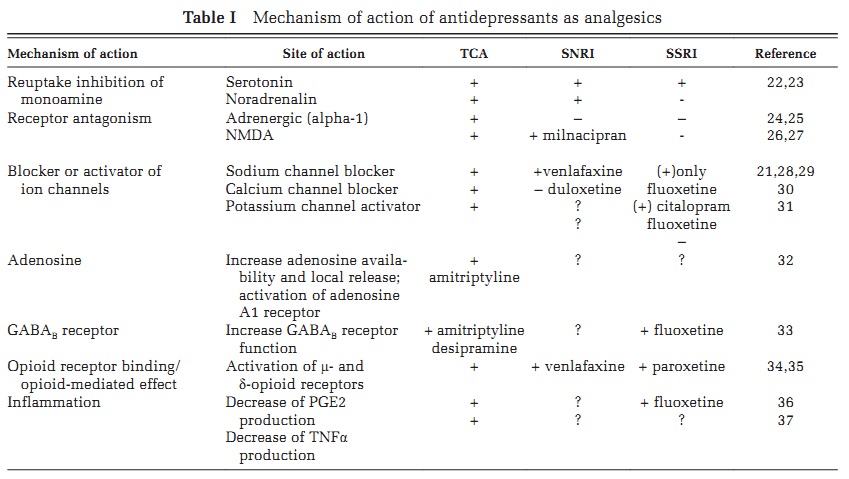
The analgesic mechanism of Cymbalta is (as with much in psychiatry) unknown.   Some have argued it works by relieving the depression and anxiety experienced by patients in pain.  It has also been proposed that it activates “descending” pathways from the brain, helping to dampen “ascending” pain signals from the body.  It might also block NMDA receptors or sodium channels or enhance the body’s own endorphin system.  (Click on the figure above for other potential mechanisms, from a recent article by Dharmshaktu et al., 2011.)

But the more important question is:  does it work?  There does seem to be some decent evidence for Cymbalta’s effect in fibromyalgia and diabetic neuropathy in several outcome measures, and in a variety of 12-week trials summarized in a recent Cochrane review.

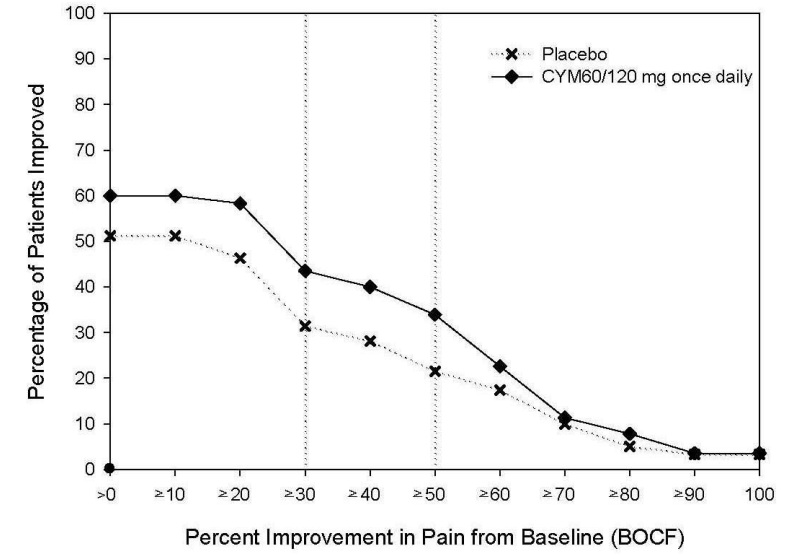
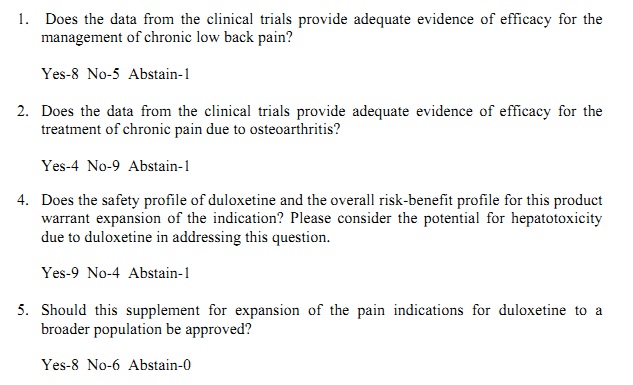
The evidence for musculoskeletal pain is less convincing.  In order to obtain approval, Lilly performed two studies of Cymbalta in osteoarthritis (OA) and three studies in chronic low back pain (CLBP).  All CLBP studies showed benefit in “24-hour pain severity” but only one of the OA studies showed improvement.   The effects were not tremendous, even though they were statistically significant (see example above, click to enlarge).  The FDA panel expressed concern “regarding the homogeneity of the study population and the heterogeneity of CLBP presenting to physicians in clinical practice.”  In fact, the advisory committee’s enthusiasm for the expanded indication was somewhat muted:

Even though the committee also complained of the “paucity of sound data regarding the pharmacological mechanisms of many analgesic drugs … and the paucity of sound data regarding the underlying pathophysiology,” they ultimately voted to approve Cymbalta for “as broad an indication as possible,” in order for “the well-informed prescriber [to] have the option of trying out an analgesic product approved for one painful condition in a patient with a similar painful condition.”

Incidentally, they essentially ignored the equivocal results in the OA trials, reasoning instead that it was OK to “extrapolate the finding [of efficacy in CLBP] to other similar musculoskeletal conditions.”

In other words, it sounds like the FDA really wanted to get Cymbalta in the hands of more patients and more doctors.

As much as I dislike the practice of prescribing drugs simply because they’re available and they might work, the truth of the matter is, this is surely how Cymbalta will be used.  (In reality, it explains a lot of what we do in psychiatry, unfortunately.)  But pain is a complex entity.  We have to be certain not to jump to conclusions—like we frequently do in psychiatry—when/if we see a “success story” with Cymbalta.

To the body, 60 mg of duloxetine is 60 mg of duloxetine, whether it’s being ingested for depression or for pain.  If a patient’s fibromyalgia or low back pain is miraculously “cured” by Cymbalta, there’s no a priori reason to think that it’s doing anything different in that person than what it does in a depressed patient (even though that is entirely conceivable).  The same mechanism might be involved in both.

The same can be said for some other medications with multiple indications.  For example, we can’t necessarily posit alternate mechanisms for Abilify in a bipolar patient versus Abilify in a patient with schizophrenia.  At roughly equivalent doses, its efficacy in the two conditions might be better explained by a biochemical similarity between the two conditions.  (Or maybe everything really is bipolar!  —sorry, my apologies to Hagop Akiskal.)

Or maybe the medication is not the important thing.  Maybe the patient’s perceived need for the medication matters more than the medication itself, and 60 mg of duloxetine for pain truly is different from 60 mg duloxetine for depression.  However, if our explanations rely on perceptions and not biology, we’re entering the territory of the placebo effect, in which case we’re better off skipping duloxetine (and its side effect profile and high cost), and just using an actual placebo.

Bottom line:  We tend to lock ourselves into what we think we know about the biology of the condition we’re treating, whether pain, depression, schizophrenia, ADHD, or whatever.  When we have medications with multiple indications, we often infer that the medication must work differently in each condition.  Unless the doses are radically different (e.g., doxepin for sleep vs depression), this isn’t necessarily true.  In fact, it may be more parsimonious to say that disorders are more fundamentally alike than they are different, or that our drugs are being used for their placebo effect.

We can now add chronic pain to the long list of conditions responsive to psychoactive drugs.  Perhaps it’s also time to start looking at pain disorders as variants of psychiatric disorders, or treating pain complaints as symptoms of mental disorders.  Cymbalta’s foray into this field may be the first attempt to bridge this gap.

Addendum:  I had started this article before reading the PNAS article on antidepressants and NSAIDs, which I blogged about earlier this week.  If the article’s conclusion (namely, that antidepressants lose their efficacy when given with pain relievers) is correct, this could have implications for Cymbalta’s use in chronic pain.  Since chronic pain patients will most likely be taking regular analgesic medications in addition to Cymbalta, the efficacy of Cymbalta might be diminished.  It will be interesting to see how this plays out.


The Painful Truth of Antidepressants

April 25, 2011

In a study published today, scientists at Rockefeller University proclaim that SSRI antidepressants (like Prozac and Celexa) may lose their efficacy when given with anti-inflammatory drugs like ibuprofen and aspirin.  Considering the high prevalence of depression and the widespread use of both SSRIs and anti-inflammatory medications, this result is bound to receive much attention.  As a matter of fact, it’s tantalizing to jump to the conclusion (as has been done in the Fox News and WSJ reports on this study) that the reason SSRIs may be so ineffective is because so many people with depression also use non-steroidal anti-inflammatory drugs (NSAIDs).

By my read of the data, it may be a bit too early to draw this conclusion.  Nevertheless, the study, by Paul Greengard, Jennifer Warner-Schmidt, and their colleagues, and published online in the Proceedings of the National Academy of Sciences, does propose some interesting mechanisms by which anti-inflammatory agents may affect antidepressant action.

The majority of the work was performed in mice, for which there are valid “models” of depression that are routinely used in preclinical studies.  In past work, Greengard’s group has shown that the expression of a small protein called p11 (which is associated with the localization and function of serotonin receptors) is correlated with “antidepressant-like” responses in mice, and probably in humans, too.  In the present study, they demonstrate that the antidepressants Prozac and Celexa cause an increase in expression of p11 in the frontal cortex of mice, and, moreover, that p11 expression is mediated by the ability of these antidepressants to cause elevations in interferon-gamma (IFN-γ) and tumor necrosis factor-alpha (TNF-α).  In other words, antidepressants enhance neural expression of these cytokines, which, in turn, increases p11 activity.

However, when mice are given NSAIDs or an analgesic (i.e., ibuprofen, naproxen, aspirin, or Tylenol), this prevents the increase in p11, as well as the increase in IFN-γ and TNF-α.  NSAIDs also prevent the “antidepressant-like” behavioral responses elicited by Celexa (as well as other antidepressants like Wellbutrin, Parnate, and TCAs) in mouse models of depression.

The group went one step further and even created a p11 “knockout” mouse.  These mice had no response to Celexa, nor did they have antidepressant-like responses to injections of IFN-γ or TNF-α.  However, the p11 knockout mice did respond to desipramine, an antidepressant that works mainly on norepinephrine, thus emphasizing the significance of serotonin in the p11-mediated response.

What does this mean for humans?  To answer this question, the group analyzed data from STAR*D, a huge multicenter antidepressant trial.  In the first stage of STAR*D, all patients (total of approximately 1500 individuals) took Celexa for a 12-week period.  The remission rate for patients who took an NSAID at any time during this 12-week period was only 45%, while those who took no NSAID remitted at a rate of 55%.

So does this mean that people taking antidepressants should avoid NSAIDs, and just deal with their pain?  Probably not. (In fact, one might ask the opposite question:  should people with chronic pain avoid SSRIs?  Unfortunately, the study did not look at whether SSRIs inhibited the pain-relieving effects of NSAIDs.)

In my opinion, some of the mouse data need to be interpreted carefully.  For instance, the mice received extremely high doses of NSAIDs (e.g., ibuprofen at 70 mg/kg/d, which corresponds to 4200 mg/d for a 60-kg man, or 21 Advil pills per day; similarly, the mice drinking aspirin received 210 mg/kg/d, or 12,600 mg = ~39 pills of regular-strength aspirin per day for a typical human).  Also, in the behavioral studies the mice received NSAIDs for an entire week but received only a single injection of Celexa (20 mg/kg, or about 1200 mg, 60 pills) immediately before the behavioral experiments.

The human data, of course, are equally suspect.  Patients in the STAR*D study were counted as “NSAID users” if they described using NSAIDs even once in the first 12 weeks of the study.  It’s hard to see how the use of ibuprofen once or twice in a three-month period might interfere with someone’s daily Celexa.  (Not to mention the fact that the “remission” data from STAR*D have come under some scrutiny themselves – see here and here).  Moreover, as the authors point out, it’s quite likely that patients with more severe forms of depression also had concurrent pain syndromes and used NSAIDs more frequently.  In other words, NSAID use might not attenuate SSRI activity, but may be a sign of depression that is more resistant to SSRIs.

In the end, however, I find the study to be quite provocative.  Certainly the correlation of antidepressant effect with expression of the p11 protein and with TNF-α and IFN-γ activity suggests a novel mechanism of antidepressant action—as well as new markers for antidepressant activity.  Moreover, the potential roles of NSAIDs in reducing antidepressant effects (or, in some cases, enhancing these effects), need to be explored.

But it raises even more unanswered questions.  For one, how do we reconcile the fact that antidepressant effects are associated with increased TNF-α and IFN-γ activity in the brain, while increases in these cytokines in the periphery are thought to cause depression?  Also, how can we explain the fact that other analgesic compounds, such as tramadol and buprenorphine, might actually have an antidepressant effect?  Finally, what does this mean for our treatment of pain symptoms in depression?  Should we avoid SSRIs and use other types of antidepressants instead?  Do NSAIDs inhibit the effects of SNRIs like Cymbalta, which has recently been FDA-approved for the treatment of chronic musculoskeletal pain (and whose users are most certainly also taking medications like NSAIDs)?

It’s great that the interface between mental illness and physical syndromes is receiving some well-deserved attention.  It’s also exciting to see that the neuroscience and pharmacology of depression and pain may overlap in critical ways that influence how we will treat these disorders in the future.  Perhaps it may also explain our failures up to now.  With future work in this area, studies like these will help us develop more appropriate antidepressant strategies for the “real world.”

[Finally, a “hat tip,” of sorts, to Fox News, which first alerted me to this article.  Unfortunately, the story, written by Dr. Manny Alvarez, was fairly low on substance but high on the “wow” factor.  It drew some broad conclusions and—my biggest pet peeve—did not refer the reader to any site or source to get more detailed information.  Alas, such is the case with much public science and medicine reporting: Alarm first, ask questions later.]


Nuedexta: “Pipeline in a Pill” or Pipe Dream?

April 18, 2011

If you’re like me, you’ve probably seen numerous Internet ads for a new medication called Nuedexta from Avanir Pharmaceuticals.  Nuedexta was approved in October 2010 for the treatment of “pseudobulbar affect,” or PBA.  My first reaction was one of surprise, as PBA is relatively uncommon, or so I was taught: why would a drug company be aggressively advertising a drug with such a niche market?  However, as I thought about the symptoms that define PBA—and then, last week, I received a Nuedexta promotional packet in the mail—I figured I should take a look “under the hood.”

First of all, I reviewed the presentation and biology of PBA.  I remember being taught in residency that it is a fairly uncommon manifestation of neurological illness, although it has a very distinctive presentation, namely, emotional expressions that are disconnected from any subjective emotional changes.  Indeed, an alternate name for it is “pathological laughing and crying.”  Certainly, the discrepancy between a patient’s emotional display—which may be extreme, and cause great distress to caregivers—and the lack of any subjective change in mood, is highly suggestive of a focal brain abnormality.

PBA is typically caused by a specific brain lesion between the cortex (the source of voluntary thought/action) and the brainstem (the source of involuntary emotional expression like laughing and crying).  Normally, we’re stimulated to laugh or cry by something funny or sad; these emotions are first processed in the cortex, which then sends a message to the brainstem to express that emotion.  If you have a lesion between your cortex and brainstem (e.g., from a stroke, multiple sclerosis, or a degenerative process) then the emotional expression can be entirely separated from the conscious awareness of it.

Over the last decade some research groups have begun to look at dextromethorphan as a potential treatment for PBA.  Dextromethorphan, also known as DXM, is a cough suppressant, the active ingredient in Robitussin, not to mention a drug often used recreationally for its dissociative and hallucinogenic properties.  Dextromethorphan is an NMDA antagonist (i.e., it prevents glutamate from activating target cells via NMDA receptors) as well as an agonist of a type of receptor called “sigma-1,” whose role is much less understood.

When dextromethorphan is combined with quinidine, another widely available drug (used to treat heart arrhythmias), the quinidine inhibits dextromethorphan’s metabolism, allowing it to penetrate the brain at doses low enough to avoid any peripheral toxicity.  Once inside the brain, it “may act on regions implicated in emotional expression” (by an unknown mechanism) and, indeed, it improves PBA symptoms with the only significant side effects being dizziness and diarrhea.  The new drug Nuedexta is a combination of 20 mg dextromethorphan and 10 mg quinidine, and the estimated cost will be from $3000-$5000 per year.

(BTW, note the theme here, which is similar to what I wrote about with Contrave:  Nuedexta is actually a combination of two existing, generic—i.e., cheap—drugs, with a significant markup, to cover the costs of clinical testing, marketing, and, of course, shareholder profits.)

Physicians—and patients—may wonder why we need a new drug to treat PBA.  Certainly, this is a good question (although I think PBA is simply Avanir’s “foot in the door,” as I’ll discuss below).  A 2007 review in the Annals of Neurology shows that a number of medications, including SSRIs like citalopram, and tricyclic antidepressants (TCAs), are effective in managing the symptoms of PBA (see also here).  And, as I mentioned earlier, the proper diagnosis of PBA requires the presence of an underlying neurological disorder, and treatment of the disorder, too, may ameliorate the PBA symptoms.

Interestingly, while I searched for literature references discussing PBA, I found that most—if not all—of the literature from the last 5-6 years has been funded or underwritten by Avanir Pharmaceuticals—and all of which discussed the benefits of dextromethorphan/quinidine.  This included an “educational review” published by the National Stroke Association in 2005.  In fact, the editors of the Annals of Neurology issue I cited above tried to get someone to write a review on PBA but couldn’t find any authors “untouched by Avanir.”  It certainly seems that Avanir’s PR effort has paid off.

The coup de grâce, in my opinion, is an “expert review” on PBA published in the journal CNS Spectrums in October 2005.  It’s a roundtable discussion on how to distinguish PBA from other psychiatric and neurologic disorders—and, of course, the benefits of dextromethorphan/quinidine.  It seems like a fair review, although the authors make comments that broaden the definition of PBA to include other disturbances of affect, which are extremely common among psychiatric patients. “It may be useful to regard affective lability,” they write, “as a disorder of affect that exists at a point on a continuum between normal affective variability and the more severe end of the continuum characterized by [PBA].”  Furthermore, they encourage clinicians to “include a specific assessment for PBA” in all patients with any neurological condition, to prevent their being “misdiagnosed” with a psychiatric disorder—the implication being that what we might call “poststroke depression” might actually be PBA.  And they even open the door to the possibility that “PBA-like” symptoms might not have a recognizable neurological basis:  “In some cases PBA may be the only clinically identifiable manifestation of the neurological condition.  In light of the overlap between the neurology of affect regulation and the neurology of psychiatric conditions, … PBA may sometimes occur in the latter context as well.” [Emphasis mine.]

You can see where this is all headed—and probably why I received a promotional packet for Nuedexta, even though I’m not a neurologist.  Here we have a new medication, which has been approved for a neurological syndrome whose major manifestation is “affective instability.”  Even though the proper diagnosis of PBA requires far more than that, clinicians will undoubtedly use it off-label for the affective lability seen in many other conditions (such as bipolar disorder, schizophrenia, autism, dementia, maybe even childhood irritability, etc).  And my bet is that Avanir will try to get Nuedexta approved for all of these conditions.

(BTW, Nuedexta has never been compared head-to-head with SSRIs or TCAs, and the trials which led to Nuedexta’s approval showed only slight improvement vs. placebo in patients with PBA due to multiple sclerosis and ALS.)

Indeed, Avanir’s investor materials (see pdf here) already state that the company will seek approval for multiple sclerosis-related pain, and for behavioral symptoms in dementia.  And when one considers how atypical antipsychotics have been affected by “indication creep,” it is probably only a matter of time before Nuedexta will be tested for other disorders characterized by affective changes, including the big kahunas: depression and bipolar disorder.  To that end, during a November 2009 conference call to shareholders, Keith Katkin, Avanir’s CEO, described Nuedexta as a “pipeline in a pill.”

I should note here that I have not tried Nuedexta so I can’t say whether it is effective.  I also have no financial interest in Avanir Pharmaceuticals.  I don’t see how Nuedexta’s pharmacological properties might control affective outbursts (but then again, I can’t explain precisely how SSRIs treat depression, either).  Certainly I’ve read of isolated cases in which Nuedexta has led to “dramatic improvement,” but those cases are from spokespeople with “skin in the game,” so to speak.  Nuedexta might be a blockbuster drug in neurology and psychiatry alike, and I’m willing to give it that chance.  However, at this stage the marketing speaks far louder than the data, and the seeds are already being sown for the more widespread use of this relatively unproven agent.  We need to be cautious not to be swayed by the influence of those who want to make a few bucks (or a few billion) off our ignorance.


Antidepressants and “Stress” Revisited

April 13, 2011

If you have even the slightest interest in the biology of depression (or if you’ve spent any time treating depression), you’ve heard about the connection between stress and depressive illness.  There does seem to be a biological—maybe even a causative—link, and in many ways, this seems intuitive:  Stressful situations make us feel sad, hopeless, helpless, etc—many of the features of major depression—and the physiological changes associated with stress probably increase the likelihood that we will, in fact, become clinically depressed.

To cite a specific example, a steroid hormone called cortisol is elevated during stress, and—probably not coincidentally—is also usually elevated in depression.  Some researchers have attempted to treat depression by blocking the effects of cortisol in the brain.  Although we don’t (yet) treat depression this way, it is a tantalizing hypothesis, if for no reason other than the fact that it makes more intuitive sense than the “serotonin hypothesis” of depression, which has little evidence to back it up.

A recent article in Molecular Psychiatry (pdf here) adds another wrinkle to the stress hormone/depression story.  Researchers from King’s College London, led by Christoph Anacker, show that antidepressants actually promote the growth and development of new nerve cells in the hippocampus, and both processes depend on the stress hormone receptor (also known as the glucocorticoid receptor or GR).

Specifically, the group performed their experiments in a cell culture system using human hippocampal progenitor cells (this avoids some of the complications of doing such experiments in animals or humans).  They found that neither sertraline (Zoloft) alone, nor stress steroids (in this case, dexamethasone or DEX) alone, caused cells to proliferate, but when given together, proliferation occurred—in other words, the hippocampal progenitor cells started to divide rapidly.  [see figure above]

Furthermore, when they continued to incubate the cells with Zoloft, the cells “differentiated”—i.e., they turned into cells with all the characteristics of mature nerve cells.  But in this case, differentiation was inhibited by dexamethasone. [see figure at right]

To make matters more complicated, the differentiation process was also inhibited by RU486, a blocker of the receptor for dexamethasone (and other stress hormones).  What’s amazing is that RU486 prevented Zoloft-induced cell differentiation even in the absence of stress hormones.  (However, it did prevent the damaging effects of dexamethasone, consistent with what we might predict.) [see figure at left]

The take-home message here is that antidepressants and dexamethasone (i.e., stress hormones) are required for cell proliferation (first figure), but only antidepressants cause cell differentiation and maturation (second figure).  Furthermore, both processes can be inhibited by RU486, a stress hormone antagonist (third figure).

All in all, this research makes antidepressants look “good.”  (Incidentally, the researchers also got the same results with amitripytline and clomipramine, two tricyclic antidepressants, so the effect is not unique to SSRIs like Zoloft.)  However, it raises serious questions about the relationship between stress hormones and depression.  If antidepressants work by promoting the growth and development of hippocampal neurons, then this research also says that stress hormones (like dexamethasone) might be required, too—at least for part of this process (i.e., they’re required for growth/proliferation, but not for differentiation).

This also raises questions about the effects of RU486.  Readers may recall the enthusiasm surrounding RU486 a few years ago as a potential treatment for psychotic depression, promoted by Alan Schatzberg and his colleagues at Corcept Pharmaceuticals.  Their argument (a convincing one, at the time) was that if we could block the unusually high levels of cortisol seen in severe, psychotic depression, we might treat the disease more effectively.  However, clinical trials of their drug Corlux (= RU486) were unsuccessful.  The experiments in this paper show one possible explanation why:   Instead of simply blocking stress hormones, RU486 blocks the stress hormone receptor, which seems to be the key intermediary for the positive effects of antidepressants (see the third figure).

The Big Picture:   I’m well aware that this is how science progresses:  we continually refine our hypotheses as we collect new data, and sometimes we learn how medications work only after we’ve been using them successfully for many years.  (How long did it take to learn the precise mechanism of salicylic acid, also known as aspirin?  More than two millennia, at least.)  But here we have a case in which antidepressants seem to work in a fashion that is so different from what we originally thought (incidentally, the word “serotonin” is used only three times in their 13-page article!!).  Moreover, the new mechanism (making new brain cells!!) is quite significant.  And the involvement of stress hormones in this new mechanism doesn’t seem very intuitive or “clean” either.

It makes me wonder (yet again) what the heck these drugs are doing.  I’m not suggesting we call a moratorium on the further use of antidepressants until we learn exactly how they work, but I do suggest that we practice a bit of caution when using them.  At the very least, we need to change our “models” of depression.  Fast.

Overall, I’m glad this research is being done so that we can learn more about the mechanisms of antidepressant action (and develop new, more specific ones… maybe ones that target the glucocorticoid receptor).  In the meantime, we ought to pause and recognize that what we think we’re doing may be entirely wrong.  Practicing a little humility is good every once in a while, even especially for a psychopharmacologist.