When Your EMR Goes Down On You

June 21, 2011

Electronic medical records (EMRs) are the way of the future.  And, for most practices, that future is today, whether we like it or not.  The federal Center for Medicare Services is paying doctors a financial incentive to switch from paper to electronic charts, and the first checks have already been cut.

It’s notable that the government has chosen to bribe doctors to switch to electronic records, when no one had to pay us (or you) to use Google or Facebook or Twitter.  Maybe it’s because EMRs don’t run like Google, Facebook, or Twitter.  Despite the tremendous potential benefits of EMRs, they remain clunky, distracting, and non-intuitive.  In their current form, their benefits are clearly limited to administrators, third-party payers, and others who are more interested in data than in the quality of care provided.  But what do I know, I’m just a doctor, and no one ever asked me.

Anyway, in the last 18 months, I’ve had the opportunity to use two different EMRs, one called Patient Care Manager by Prime Clinical (about which I can’t find much positive to say, so I’ll keep my mouth shut), and another, Practice Fusion.  I must admit I’ve been rather impressed by Practice Fusion, a free “cloud-based” EMR system with many user-customizable features and a surprisingly simple interface.

Alas, for several hours yesterday—right in the middle of a busy Monday—Practice Fusion went down.   As in:  totally unavailable.  Couldn’t log on, couldn’t view any charts, lab reports, patient correspondence, or the daily schedule.  Couldn’t even look at patient demographics.  It was as if the entire chart rooms of hundreds of doctors’ offices across America were closed for the day.

In a conventional practice with paper charts, this sort of thing is unacceptable.  To be sure, things get lost every once in a while, but to lose access to an entire chart room—and schedule—without any idea of when it will return, is a potentially very serious problem.  Doctors have been severely disciplined for losing or missing data (even in individual cases), and clinics have been penalized with significant fines for shoddy recordkeeping.

Fortunately, Practice Fusion came back up late in the day, but not until hundreds of practices across the country struggled for 5-6 hours without vital information, making for a very difficult Monday.

I should point out that (when it works) Practice Fusion is unique.  More so than any other EMR I’ve used, PF is extremely user-friendly, offering informative (and sometimes humorous and irreverent) YouTube videos, live online chat, and an attentive support team.  They even allow comments on their public Facebook page.  You might expect it to be a place for doctors to vent their outrage on a day like yesterday.  To the contrary, most of the comments were quite sympathetic.  Some direct quotes:

“I feel like I’m deaf and blind… could not pull labs or test results…. I know it happens. It could happen even to the best. But hey! It’s not the end of the world!  True, it’s very inconvenient since I’ll be spending most of my evening trying to catch up charting.  But still… Love you guys! Keep up the good work!”

“I love Practice Fusion no matter what happened today… Good job guys!!!”

“We are thankful for PF, even with the RARE problem…. Thanks to you and the team for providing us a reliable and FREE EMR.”

“If it’s going to stay this fast [after the outage] I can get over being down today though it was quite stressful!  Thank you PF staff.  You were probably stressed too.”

It’s a surprising commentary when a very significant glitch in a widely used EMR system—which, in a conventional practice situation, might have resulted in disciplinary action or heavy fines, and which most certainly resulted yesterday in lost income for a number of docs and probably more than a few adverse patient outcomes—was accepted with such grace.

Maybe I’m old-fashioned, but EMRs are not like any other piece of software.  When Netflix goes down, I can’t watch a streaming movie.  But when Practice Fusion goes down, I can’t access vital information which may make a significant impact on the well-being of the patients in my office.  It’s a very slippery slope when we “permit” EMRs to be buggy, and even worse when we providers simply “accept” it (and even give the companies a free pass) when they go down.

But then again, the future is today.  We need to get used to it.


I Want a DSM Wiki

June 8, 2011

As most readers of this blog are well aware, the American Psychiatric Association will publish its latest version of the Diagnostic and Statistical Manual (the hallowed “DSM”) in 2013.  The next version will be version 5.  (Note, it’s “5,” not “V.”  This is so that follow-up versions can be named 5.0.1, 5.1, 5.1.1, etc.  Just like computer software.  I kid you not.)

The provisional criteria have been made public, and the APA invites anyone to comment on its website, dsm5.org.  (The full development process was not this transparent.  Allen Frances and Robert Spitzer, two dissidents, famously decried the “nondisclosure agreements” the book’s authors had to sign.  Spitzer even commented, “The intent seemed to be not to let anyone know what the hell was going on.”)

But as we get closer to the publication date, readers can have a closer look under the hood.  Anyone can surf over to their website and make comments.  Yes, now is your chance to let the leaders of the psychiatric profession know precisely what you think about the new “Somatic Symptom Disorder” diagnosis; challenge the possible removal of the “narcissistic” category; or just tell the authors that you think psychiatry is all a crock of s***.

In an interview published today on Medscape, David Kupfer, chair of APA’s DSM-5 task force, reports that this spirit of openness and flexibility will likely persist even after its publication.  He says the upcoming DSM-5 will be a “living document,” complete with an electronic version (probably online?) which will be “much easier to update and may even include links to videos and vignettes.”

That could be a big step forward.  Imagine: if you’ve never seen catatonia before, you might be able to click on the DSM-5 entry and see a video of a catatonic person.  If your patient doesn’t understand why you just diagnosed her with borderline personality, you can read her a descriptive vignette (so much more interesting than a checklist!) and she’ll get it.

My thinking is, why stop there?  Psychiatrists are already way behind the times when it comes to modern technology.  Our peers in other specialties get to use fancy doodads like MRI scanners and bypass machines and stents all day long.  We just sit around and talk to people.

And then it hit me:  the APA should create a DSM-5 wiki.

For those of you who have no idea what a “wiki” is, it’s a website developed collaboratively by users and visitors.  Any user can add content, and it’s edited in real time by other users.  Disputes are resolved by online discussion, and historical changes can be viewed by anyone.  Perhaps the most famous example of a wiki is Wikipedia, the online encyclopedia.  Those articles were not first published in a book somewhere; instead, they have been written by experts and non-experts alike, and are constantly being edited.  Wikipedia has, for better or for worse, come to replace conventional encyclopedias and is a remarkably accurate (and free) source of material.

Maybe the APA can do the same!  Let’s put the DSM-5 online and let people do whatever they want with it.

Imagine the uses.  A DSM-5 wiki would let clinicians chime in about what they think ought to be changed or added, like an interesting “subtype” of an existing disorder.  Similarly, scientists could share findings that might be relevant to diagnosis (like newly discovered biomarkers) and clinicians could share novel uses of off-label medications, therapeutic successes, and interesting case reports.

Each medication could have its own Wiki page, with complete FDA approval information and dosing.  Herbals could be included.  To be fair, pharmaceutical companies would have free access to their documents, but any changes made by industry would be flagged as such.  Users could even upload cost data to help patients find affordable generic alternatives.

But the APA needs to make an even stronger statement that we’re not just old guys sitting around smoking pipes.  We need to go balls to the wall.  We could allow users to upload videos of unique patient presentations (with the proper HIPAA safeguards in place, like black rectangles over patients’ eyes, etc), public-domain lectures by famous psychiatrists, and links to journal articles describing new and relevant findings.  We could also add references to fascinating psychiatry blogs like this one. (lol)

Patients could also upload their own experiences, in YouTube format.  Their videos would be cross-referenced to the relevant diagnoses and/or medications.  Videos with the most “hits” could win a prize.  Maybe we can link terms to their Urban Dictionary entries.

We could add clips from Hollywood movies depicting particular disease presentations.  We could add links to Amazon.com to purchase relevant books (and use the Amazon Associates revenue to help manage server costs).  We could include a Skype plug-in that would allow users to chat with other people logged on at the  same time.  We could even sell space to advertisers like Groupon (“10 sessions of psychotherapy for the price of 5 in Chicago!!”) or, for those over 21, porn sites (targeted specifically to readers of the “Paraphilias” entry).

Social media is the future, and the APA really needs to get with the program!  An animated GIF logo.  An MP3 theme playing in the background of each page.  A Flash-based interface (sorry, iPad users).  The APA could even create new, edgy slogans for itself and for the DSM.  For instance, it’s not DSM-5 anymore, it could be “D5M-ph!\/3”.  It’s not just a “living document,” it can be the most 4w3soM3 social media psychiatry destination on the planet!   OMG!!!!!!1!

Let’s do it.


How Not To Be A Difficult Patient

June 5, 2011

One of the more interesting posters at last month’s American Psychiatric Association Annual Meeting was presented by Ricardo Salazar of UT San Antonio and the South Texas Psychiatric Practice-Based Research Network (PBRN).  The topic was “the Difficult Patient in Psychiatric Practice” and it surveyed psychiatrists about which patients they considered “difficult” and why.

It might sound somewhat disrespectful (and maybe a little naïve) to label a patient as “difficult.”  However, doctors are people too, and it would be even more naïve to think that doctors don’t have their own reactions to (and opinions of) the patients they treat—something referred to in psychoanalytic theory as “countertransference.”  Let’s face it:  doctors simply don’t like dealing with some patients.  (That’s why some choose private practice, to cherry-pick those whom they do like.)

Nevertheless, I think this topic needs more attention, particularly in today’s environment.  Much of what we do in mental health (both psychopharmacologically and in therapy) has a questionable evidence base, and yet the experience of clinicians and of patients is that our interventions frequently work.  I maintain that clinical benefit often results more from the interpersonal relationship between a patient and a doctor who listens and seems to understand, than from the pill that a doctor prescribes or the specific protocol that a therapist follows.  (This is yet another reason why quick-throughput psychiatry, dictated by brain scans, blood tests, and checklists, is bound to fail for most patients.)

Anyway, Dr Salazar’s study used a scale called the “Difficult Doctor-Patient Relationship Questionnaire (DDPRQ-10),” developed by Steven Hahn and colleagues in 1994.  I had not heard of this scale before.  Here are some sample questions:

1.  How much are you looking forward to this patient’s next visit after today?
3.  How manipulative is this patient?
4.  To what extent are you frustrated by this patient’s vague complaints?
6.  Do you find yourself secretly hoping this patient will not return?
8.  How time-consuming is caring for this patient?

As a patient, I might find some of these questions mildly offensive (“does my doctor secretly hope I won’t return??”), but as a doctor I must admit that some days I look at my schedule and see a name that makes me dread that hour.  (If you’re a doctor and you’re reading this and you do not agree, you’re either fooling yourself, you’re perfect, or you’re IBM’s Watson.)  Recognizing those feelings, however, often helps me to prepare for the session—and examine my own biases and faults—and such appointments often turn out to be the most satisfying (at least for the patient).

Salazar’s study showed that, on average, psychiatrists considered approximately 15% of their patients to be “difficult.”  The most common diagnoses among the “difficult” patients were schizophrenia (32%), bipolar disorder (19%), cognitive disorder (24%), and personality disorder (32%).  Patients with depression (11%) or anxiety (9%)—and, interestingly, patients who were in psychotherapy (11%)—were considered less difficult.  Not surprisingly, patients with alcohol and substance use disorders were also labeled difficult (23%), but patients with somatization (defined in this study as “unexplained physical complaints”) were less so (10%).

A fascinating review of 94 studies published between 1979 and 2004 described four reasons why patients may be considered “difficult”:  (1) chronicity– i.e., patients fail to improve over time; (2) severe, unmet dependency needs which patients then project onto the caregiver; (3) severe character pathology (especially borderline, narcissistic, and paranoid types); and (4) an inability to “reflect” (which the authors attribute to a history of insecure attachment early in life).  The authors also described three types of difficult patients:  the “unwilling care avoider” who doesn’t see himself as sick; the “ambivalent care seeker” who is often demanding and dependent, but is frequently self-destructive and self-sabotaging; and the “demanding care claimer” who is aggressive, attention-seeking and manipulative, but who sees himself as a patient only when necessary to achieve his own goals (legal, financial, or otherwise).

Of course, every patient interaction is a two-way street.  Regarding psychiatrists, the Salazar study found that young (<40 yrs old) psychiatrists, and those working in a group practice, claimed to have more difficult patients.  Another large study published in 2006 examined 1391 physicians to identify which features of doctors underlie their perceptions of patients as “frustrating.”  They found that high frustration was associated with doctors who were younger (<40 yrs old), worked >55 hrs/week, had symptoms of depression, stress, or anxiety (yes, that’s in the doctor, not the patient), and had “a greater number of patients with psychosocial problems or substance abuse.”  Two-way street, indeed.

It’s commonly said that “there’s no such thing as a stupid question.”  By the same token, I would posit that there’s no such thing as a difficult patient.  To be sure, some patients present with difficult problems, challenging histories, poor interpersonal skills, and needs that simply can’t be met with the interventions available to the physician.  But every patient suffers in his or her own way.  Doctors bring their own baggage to the interaction, too, in the form of strong opinions, personal biases, lack of knowledge, or—conversely—the perception that we know what’s going on, when in reality we do not.

When you add in the extrinsic factors that make the interaction even more strained—shorter appointments, care that is dictated by some third party rather than the doctor or the patient, poorly designed electronic medical record systems, or financial conflicts of interest that violate the doctor-patient trust—the “difficulties” just keep piling up.

It’s important that we look at every aspect of the doctor-patient interaction in order to improve the quality and efficacy of the care we provide.  Patients should not need to worry about whether they’re perceived as “difficult” or “frustrating.”  And when these perceptions do exist, we must critically examine the impact it has on their care, and what it says about the professionals we call upon to treat them.


Biomarker Envy II: Ethanolamine Phosphate

May 27, 2011

In my inbox yesterday was a story describing a new biological test for a psychiatric disorder.  Hallelujah!  Is this the holy grail we’ve all been waiting for?

Specifically, scientists at Human Metabolome Technologies (HMT) and Japan’s Keio University presented data earlier this week at a scientific conference in Tokyo, showing that they could diagnose depression by measuring levels of a chemical—ethanolamine phosphate—in patients’ blood.

Let me repeat that once again, for emphasis:  Japanese scientists now have a blood test to diagnose depression!

Never mind all that messy “talk-to-the-patient” stuff.  And you can throw away your tired old DSM-IV, because this is the new world: biological diagnosis!!  The press release describing the research even suggests that the test “could improve early detection rates of depression if performed during regular medical checkups.”  That’s right:  next time you see your primary doc, he or she might order—along with your routine CBC and lipid panel—an ethanolamine phosphate test.  If it comes back positive, congratulations!  You’re depressed!

If you can detect the skepticism in my voice, good.  Because even if this “biomarker” for depression turns out to be 100% accurate (which it is not—see below), its use runs entirely against how we should be practicing person-centered (not to be confused with “personalized”) medicine.  As a doctor, I want to hear your experiences and feelings, and help you with those symptoms, not run a blood test and order a drug.

[Incidentally, the Asahi press release made me chuckle when it stated: “About 90 percent of doctors base their diagnosis of depression on experience and varying factors.”  What about the other 10%?  Magic?]

As it turns out, I think there’s a lot to suggest that this particular blood test may not yet be ready for prime time.  For one, the work has not yet been published (and deciphering scientific results from a press release is always a risky proposition).  Secondly, the test was not 100% accurate; it failed to identify depression in 18% of cases, and falsely labeled healthy people as “depressed” 5% of the time.  (That’s a sensitivity of 82% and a specificity of 95%, for those of you playing along at home.)

Further, what the heck is ethanolamine phosphate, and why would it be low in depressed people?  Is it a chemical secreted by the “happiness centers” of the brain?  Does it predict the onset or worsening of a depressive episode?  Is it somehow affected by antidepressant treatment?  As far as I can tell from a quick literature search, there has been no report—or even a suggestion—of ethanolamine (or any of its metabolites) being involved in the pathogenesis of mood disorders.  Then again, maybe I didn’t get the Japanese translation just right.

Anyway, where this “marker” came from is anybody’s guess.  It’s entirely possible (although I can’t be sure, because the Japanese group has not yet published their findings) that the researchers measured the blood levels of dozens of molecules and found the “best” results with this one.  We sometimes call this a “fishing expedition.”  Obviously, the finding has to be replicated, and if it was, in fact, just a lucky result, further research will bear that out.

But Dr Yoshiaki Ohashi, board director and chief security officer at HMT (“chief security officer”? does he wear a badge and sit at the front desk during the overnight shift, too?) maintains that the findings “will make it easier for an objective, biological diagnosis of depressive patients.”

Wow.  In 2011.  (And just in time for DSM-5.)

What if he’s right?  How would you feel if you went to a routine doctor’s visit next week, got an order for blood work, and a secretary called you a few days later to tell you that you have depression?  Even if you don’t feel depressed?

Were there other motives for developing such a test?  Probably.  One of the press releases quotes the Japanese Ministry of Health as saying that “only one quarter of the people who need treatment” actually get it.  So maybe this blood test is simply a way to offer treatment to more people expand the market for antidepressants—even to those who don’t want treatment.  And then, of course, HMT probably wants a piece of the pie.  HMT is already developing a commercial test to measure ethanolamine phosphate levels; obviously, widespread adoption of this test would translate into big bucks for HMT, indeed.

So while many other questions remain to be answered, I must say I’m not holding my breath. Biological screening tests for psychiatric disorders have no face validity (in other words, if a test is positive but a person shows no signs or symptoms, then what?) and a positive result may expose patients to “preventive” treatments that are costly and cause unwanted side effects.

In my opinion, the best way (if any) to use a biomarker is in a “confirmatory” or “rule-out” function.  Is that demoralized, ruminative, potentially suicidal patient in your office simply going through a rough period in her life?  Or is she clinically depressed?  Will she respond to medications, or is this something that will simply “pass”?  In cases like this, measuring ethanolamine phosphate (or another similar marker) might be helpful.

But I don’t think we’ll ever be able to screen for psychiatric illness the same way a primary care doc might screen for, say, breast cancer or diabetes.  To do so would redefine the entire concept of “mental” illness (perhaps making it “neurological” illness instead?).  It also takes the person out of the picture.  At the end of the day, it’s always the patient’s thoughts, words, and experiences that count.  Ignoring those—and focusing instead on a chemical in the bloodstream—would be an unfortunate path to tread.


CME, CE, and What Makes A Psychiatrist

May 25, 2011

Why do psychiatrists do what they do?  How— and why— is a psychiatrist different from a psychotherapist?  I believe that most psychiatrists entered this field wanting to understand the many ways to understand and to treat what’s “abnormal,” but have instead become caught up in (or brainwashed by?) the promises of modern-day psychopharmacology.  By doing so, we’ve found ourselves pigeonholed into a role in which we prescribe drugs while others provide the more interesting (and more rewarding) psychosocial interventions.

Exceptions certainly do exist.  But psychiatrists are rapidly narrowing their focus to medication management alone.  If we continue to do so, we’d better be darn sure that what we’re doing actually works.  If it doesn’t, we may be digging ourselves a hole from which it will be difficult—if not impossible—to emerge.

How did we get to this point?  I’m a (relatively) young psychiatrist, so I’ll admit I don’t have the historical perspective of some of my mentors.  But in my brief career, I’ve seen these influences:  training programs that emphasize psychopharmacology over psychotherapy; insurance companies that reimburse for medication visits but not for therapy; patients who demand medications as a quick fix to their problems (and who either can’t access, or don’t want, other therapeutic options); and treatment settings in which an MD is needed to prescribe drugs while the “real work” is done by others.

But there’s yet another factor underlying psychiatry’s increasing separation from other behavioral health disciplines:  Continuing Medical Education, or CME.

All health care professionals must engage in some sort of professional education or “lifelong learning” to maintain their licenses.  Doctors must complete CME credits.  PAs, nurses, psychologists, social workers, and others must also complete their own Continuing Education (CE) credits, and the topics that qualify for credit differ from one discipline to the next.

The pediatrician and blogger Claudia Gold, MD, recently wrote about a program on “Infant-Parent Mental Health,” a three-day workshop she attended, which explored “how early relationships shape the brain and influence healthy emotional development.”  She wrote that the program “left me well qualified to do the work I do,” but she couldn’t receive CME credits because they only offered credit for psychologists—not for doctors.

I had a similar experience several years ago.  During my psychiatry residency, I was invited to attend a “Summit for Clinical Excellence” in Monterey, sponsored by the Ben Franklin Institute.  The BFI offers these symposia several times a year; they’re 3- or 4-day long programs consisting of lectures, discussions, and workshops on advanced mental health topics such as addictions, eating disorders, relationship issues, personality disorders, trauma, ethics, etc.—in other words, areas which fall squarely under the domain of “mental health,” but which psychiatrists often don’t treat (mainly because there are no simple “medication solutions” for many of these problems).

Even though my residency program did not give me any days off for the event (nor did they provide any financial support), I rearranged my schedule and attended anyway.  It turned out to be one of the most memorable events of my training.  I got to meet (yes, literally meet, not just sit in an audience and listen to) influential figures in mental health like Helen Fisher, Harville Hendrix, Daniel Amen, Peter Whybrow, and Bill O’Hanlon.  And because most of my co-attendees were not physicians, the discussions were not about medications, but rather about how we can best work with our patients on a human and personal level.  Indeed, the lessons I learned there (and the professional connections I made) have turned out to be extraordinarily valuable in my everyday work.  (For a link to their upcoming summits, see this link.  Incidentally, I am not affiliated with the BFI in any way.)

Unfortunately, like Dr Gold, I didn’t receive any CME credits for this event either, even though my colleagues in other fields did get credit.  A few days ago, out of curiosity, I contacted BFI and inquired about their CME policy.  I was told that “the topic [of CME] comes up every few years, and we’ve thought about it,” but they’ve decided against it for two reasons.  First, there’s just not enough interest.  (I guess psychiatrists are too busy learning about drugs to take time to learn about people or ideas.)  Second, they said that the application process for CME accreditation is expensive and time-consuming (the application packet “is three inches thick”), and the content would require “expert review,” meaning that it would probably not meet criteria for “medical” CME because of its de-emphasis of medications.

To be fair, any doctor can attend a BFI Summit, just as anyone could have attended Dr Gold’s “Infant-Parent Mental Health” program.  And even though physicians don’t receive CME credits for these programs, there are many other simple (and free, even though much of it is Pharma-supported) ways to obtain CME.

At any rate, it’s important—and not just symbolically—to look at where doctors get their training.  I want to learn about non-pharmacological, “alternative” ways to treat my patients (and to treat patients who don’t fit into the simple DSM categories—which is, well, pretty much everyone).  But to do so, it would have to be on my own dime, and without CME credit.  On the other hand, those who do receive this training (and the credit) are, in my opinion, prepared to provide much better patient care than those of us who think primarily about drugs.

At the risk of launching a “turf war” with my colleagues in other behavioral health disciplines, I make the following proposal: if psychologists lobby for the privilege to prescribe medications (a position which—for the record—I support), then I also believe that psychiatrists should lobby their own professional bodies (and the Accreditation Council for CME [ACCME]) to broaden the scope of what counts as “psychiatric CME.”  Medications are not always the answer.  Similarly, neurobiology and genetics will not necessarily lead us to better therapeutics.  And even if they do, we still have to deal with patients—i.e., human beings—and that’s a skill we’re neither taught nor encouraged to use.  I think it’s time for that to change.


Horizant: The Second Coming of Gabapentin

April 8, 2011

Like the religious notion of reincarnation, apparently some drugs are destined to be reborn as newly designed and re-packaged drugs for brand new indications.  I’ve written about Contrave and Silenor, for instance—two drugs with generic equivalents that have been re-tweaked, re-packaged, and renamed, for newer (and larger) markets.

This week, the FDA granted its approval to yet another “new” agent (that’s “new” with an asterisk, mind you), Horizant, developed by GlaxoSmithKline (GSK) and Xenoport.  Horizant is a name-brand version of gabapentin, which is also known as Neurontin.  While on the surface this appears to be an attempt to re-brand an existing drug, it may actually provide some advantages over the already-available alternative.  But the question is, at what cost?  And for what exactly?

Gabapentin was approved in 1994 and is marketed as Neurontin.  It’s approved for the treatment of partial seizures and post-herpetic neuralgia (although its manufacturer, Pfizer, got into some serious trouble for extensive off-label marketing of this compound—so what else is new?).  These days, it’s actually quite widely used by neurologists and psychiatrists, not just for seizures, but also for  chronic pain syndromes, anxiety, mood stabilization (where it’s not particularly effective), and even for alcohol dependence.

Gabapentin’s bioavailability—the ability of the drug to enter the bloodstream when taken as an oral dose—is rather low (and, paradoxically, decreases as the dose is increased) and the duration of its action is quite short, which means that users need to take this drug three or four times daily.  The key advantage of Horizant is that it is a “pro-drug.”  Technically it’s gabapentin enacarbil, and the “enacarbil” refers to a molecule added to the drug which allows it to be absorbed along the entire GI tract, resulting in greater blood levels.

(Interestingly, in early 2010 the FDA rejected Horizant’s first request for approval, citing a small but significant risk of cancer.  They relented, however, and approved it this year after “reconsidering the risks and benefits.”  Sound fishy?  No, I’m sure it’s all good.)

So who might use Horizant?  Well, you can bet that GSK and Xenoport hope that anyone who currently uses Neurontin (and there are a lot of them) is a potential customer patient.  Officially, though, it was approved for the treatment of restless legs syndrome (RLS).

Now, RLS is one of those “diseases that may not be diseases”—or “diseases that you didn’t know you had.”  (See the articles here and here for accusations of “disease mongering” by GSK [hey! GSK! Coincidence? I don’t think so!] when it introduced Requip, the first “treatment” for RLS.)  Hopefully it goes without saying that when you see headlines like “Disease X may affect  7-10% of the population” when, in fact, no one had even heard of Disease X ten years ago, you have to be somewhat suspect.

Nevertheless, like much else in psychiatry, there may be some reality to RLS; it may in fact be a true pathophysiological entity that responds to medication.  (Whether this entity afflicts 10% of the population is another story.)  Current treatment strategies involve dopamine replacement, in the form of Requip (ropinirole) or Mirapex (pramipexole) so maybe dopamine insufficiency is part of the process.

The symptoms of RLS are “an urge to move the limbs, which improves with activity and worsens with rest.”  That’s about it.  Which leads to yet another problem (a problem that GSK and Xenoport don’t see as a problem, that’s for sure): with such nonspecific and common symptoms (who among us hasn’t felt somewhat restless, with interrupted sleep?), a lot of people might get diagnosed with RLS when their symptoms are actually due to something else.

I thought of this a few weeks ago, when I saw that the RLS “patient page” on the National Institutes of Health (NIH) web site referred to RLS as “akathisia” (thanks to altmentalities for the link).  Akathisia (from the Greek for “not sitting still”) has long been recognized as a side effect of some—perhaps most—psychiatric medications, from antipsychotics to antidepressants.  It is often described as an “inner restlessness,” a “need to keep moving.”  Sometimes it’s associated with extreme emotional distress.  In terms of severity, it can range from a mild nuisance to—in some cases—aggressive tendencies.  (Indeed, the psychiatrist David Healy has even linked psychotropic-induced akathisia to suicide attempts and violent behavior.)

Psychiatrists really don’t know exactly what causes akathisia, and disagree on how to treat it.  It may have something to do with dopamine blockade, or something completely independent.  Treatment might consist of benzodiazepines (like Ativan or Valium), beta blockers (like propranolol), or discontinuing the drug that caused it in the first place.

Unlike RLS, which seems to bother people most when they are lying down (hence its tendency to disrupt sleep), drug-induced akathisia is worse when people are awake and moving around.  Sounds like a simple distinction.  But nothing is quite this simple, particularly when psychiatric drugs—and real people—are involved.   In fact, many psychiatric meds can cause other motor side effects, too, involving (theoretically) yet other neural pathways, such as “parkinsonian” side effects like rigidity and tremor.  (In fact, some antipsychotic drug trials show “restlessness” and “akathisia” as entirely separate side effects, and when I’ve tried to ask experts to explain the difference, I have never received a straightforward answer.)

So what does this all mean for Horizant?  I could be cynical and simply remark that GSK/Xenoport are capitalizing on the nonspecificity of symptoms, the tremendous diagnostic overlap, and the fact that motor side effects, in general, are common side effects of antipsychotics (one of the most widely prescribed drug classes worldwide).  In other words, they know that there are a lot of people out there with “restless legs” for all kinds of reasons, and lots of psychiatrists who will misdiagnose akathisia as RLS and prescribe Horizant for this purpose.  But in reality, that remark would not be all that cynical.  Remember, there is this pesky little thing called “return on investment.”

What it means for the patient (or should I say “customer”) is more confusing.  A new agent with apparently better availability and kinetics than gabapentin is now available, but approved for the treatment of something that may or may not exist (in most patients), and may or may not be more effective than gabapentin itself.  Oh, and a hefty price tag, too.  Ah, the wheels of psychopharmacology keep turning….

(NB: altmentalities has also written her point of view on the Horizant story… I suggest you check it out, too.)


EMRs and Zombie Psychiatry

April 5, 2011

I consider myself to be a fairly tech-savvy guy.  I grew up in the 80s and computers have been a part of my leisure time, my academic life, and my work environment for as long as I can remember.  But using an electronic medical record (EMR) is testing my patience.

More importantly, it’s yet another example of an external influence which is changing the practice of psychiatry.  And not for the better.

I learned how to practice medicine from teachers who valued the essence of the interpersonal relationship between patient and doctor.  What attracted me to psychiatry in particular was the fact that in this field, these unspoken and unquantifiable aspects of the doctor-patient dyad are paramount, much more so than in any other medical specialty.  The patient’s subjective feelings about the therapeutic relationship—the patient’s unconscious transference of experience from past relationships into the present, for example—are as much a part of the therapeutic process as his or her verbal reports or directly measurable behavioral symptoms.  The “soul” of psychiatry lies in this nonverbal interaction.

Moreover, this relationship transcends time.  For as much as we like to bemoan the “15-minute med check” appointment, the truth is that fifteen minutes is plenty of time for an expert clinician to get an overall feeling for a patient—the “Gestalt” impression that informs the treatment process.  By the same token, a one-hour session by a poorly trained clinician is nothing more than data gathering.

EMRs are changing how we document information.  One could argue, correctly, that documentation has always been an important part of clinical care, and not directly related to the doctor-patient relationship.  However, a well-written note (not to mention the exquisitely detailed psychodynamic case formulations from years past) can convey a rich trove of information about a patient’s history, symptoms, underlying pathology, and future goals.

The type of information we document in an EMR, however, is different.  I’ve commented elsewhere that the ideal EMR for a psychiatrist would be a word processor and an encrypted hard drive.  Nothing more.  Just let me enter all the information that I think is relevant in a given session and save it for next time.

But EMRs weren’t designed for the psychiatrist or the patient.  They were designed for administrators, billing experts, lawyers, insurance companies, and others who care more about the quantifiable aspects of the interaction (the diagnosis, the medication prescribed, the presence/absence of discrete symptoms) than about the patterns of symptoms, the clinician’s subjective assessment, and the hypotheses underlying the patient’s behavior which are being actively tested in the therapeutic relationship.

The amount of time it takes me to document everything that is required for “correct billing” of my appointments (and to double-check everything, lest I get a call from my administrator the next day to “fix the chart”) takes up virtually the entire scheduled appointment time.

But my concern here is not about the time it takes, or even about the nuisance of having to click on a few dozen boxes during each patient encounter, or open six different documents—in different formats, in non-overlapping windows—to see what’s happened since a patient’s last visit.  (I like to think that I’m a quick enough learner to do all of that.)  My concern instead is with how I’m now starting to think of patients not as human beings with interesting and complicated histories which inform my care, but rather as collections of symptoms which change from visit to visit.

EMRs demand measurement and assessment of patients on scales that are, for the most part, arbitrary, and which may be completely “off the mark” vis-à-vis what’s really happening in a person’s life.  They ask us to quantify things that cannot be quantified, and distract our attention from what might be truly significant in the patient’s life at the time of the encounter.

Hey, maybe that’s okay.  After all, it’s the monthly visits by patient 2010-00224, dx code 296.34, that pay the bills.  And as long as I’ve checked the boxes next to “depressed mood” or “insomnia” or “feelings of guilt” (not to mention the other two-dozen boxes I need to check for his mental status exam and review of systems), and updated his problem list, and made sure I checked the box indicating he isn’t suicidal (never mind whether I actually asked him or not), that counts as “good” care.

But by this time, I’m not a psychiatrist.  Heck, I’m not even a human, I’m entranced, soulless, and following someone else’s commands.  A zombie.  And patient 2010-00224 deserves more than that.


The Dangerous Duality of “Dual Diagnosis”

March 23, 2011

When psychiatric illness coexists with a substance use disorder, we refer to this as a “dual diagnosis.” This term makes clear that we’re talking about two conditions in the same person, which could exist independently of each other (hence they’re also sometimes called “co-occurring disorders”), rather than one disorder causing the other—as seen, for example, in cases of a methamphetamine-induced psychotic reaction or an alcohol-induced depression.

Of course, no two conditions in medicine ever exist truly independently of each other, particularly in psychiatry, and the high prevalence of “dual diagnosis” patients (more than a third of alcoholics, for example, have a co-occurring mental illness, and at least 20% of persons with a mood disorder have a drug use problem) suggests that there’s something about mental illness that makes people more susceptible to addictive disorders, and vice versa.

A “dual diagnosis” label should, theoretically, draw attention to the special concerns these patients face, and to the need for specialized and integrated treatment.  Unfortunately, in practice, this rarely occurs.  Instead, this knowledge often results in compartmentalized care, which may have unfortunate consequences for the dually diagnosed.

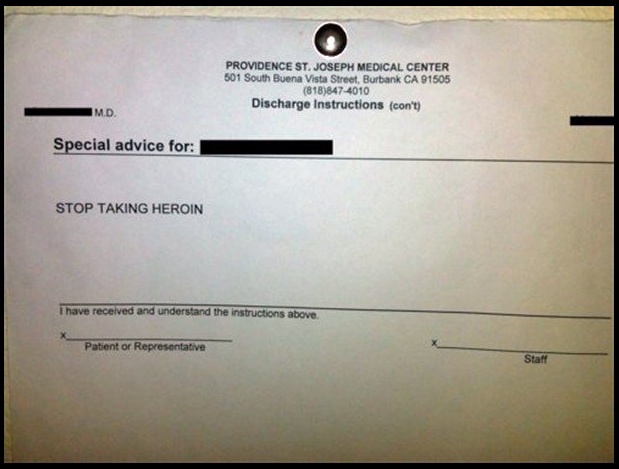
How so?  Consider an inpatient psychiatric ward.  Patients are admitted to these units for brief “acute stabilization,” when they are actively symptomatic, often with psychosis, thoughts of suicide, or other poorly controlled symptoms.  Because these hospitalizations are very short, there’s little or no opportunity to engage in meaningful addiction treatment.  Even when the immediate precipitant of the patient’s acute episode is identified as the abuse of a drug or alcohol, we often discharge patients with little more than a written instruction to “go to AA” or “consider rehab” (or my personal favorite, shown above [click for larger version], which would be funny if it weren’t real).  Similarly, in the psychiatrist’s office—particularly when the visits are only 10 or 15 minutes long—there’s usually no time to discuss the addiction; at best, the patient might get something along the lines of, “oh, and be sure to try to cut down on your drinking, too.”

Even though this is commonplace, it sends a powerful yet dangerous message to the addict:  it says that his addiction is less important than the mental disorder, less worthy of treatment, or, perhaps, impossible to treat.  It might signal to the addict that his psychiatrist is unwilling or unable to talk about the addiction, which may be (subconsciously) interpreted as a tacit approval of the addictive behavior.  (If you think I’m exaggerating, then you’ve probably never experienced the overwhelming power of addictive thinking, and its unique ability to twist people’s judgment and common sense in extreme ways.)

It’s also just bad medicine.  As any ER psychiatrist can attest, substance-induced exacerbations of mental illness are rampant and a major cause of hospital admissions (not to mention medication noncompliance, aggression, criminal activity, and other unwanted outcomes).  Ignoring this fact and simply stabilizing the patient with the admonition to “consider” substance use treatment is unlikely to improve the long-term outcome.

In the drug or alcohol treatment setting, the situation is often quite similar.  Sometimes a therapist may not be aware of a patient’s mental health history or active symptoms, in which case he or she might have unrealistically high expectations about the patient’s progress. On the other hand, if the patient is known to carry a psychiatric diagnosis, a therapist might incorrectly attribute even the slightest resistance—and addicts show a lot of it—to that mental illness (even when the symptoms are well-controlled) and miss the opportunity to make substantial inroads in treatment.  Neither alternative “meets the addict where he is,” challenging him with demands that are appropriate for his capabilities and his level of understanding.

True “dual diagnosis” treatment, where it exists, involves close interaction among addiction therapists, rehab counselors, psychiatrists, and others involved in the mental, physical, social, and spiritual well-being of each patient.  Some psychiatrists are well-versed in the nature of addiction (those who have first-hand experience of addiction and recovery are often well positioned to understand the demands on the recovering addict), and, similarly, some addiction experts are adept at identifying and managing symptoms of mental illness.  With this combination, patients can benefit from individualized treatment and are given fewer opportunities to fly beneath the proverbial radar.

However, for most patients this is the exception rather than the rule.  “Addition psychiatrists” are sometimes little more than prescribers of a replacement therapy like Suboxone or naltrexone, and rehab programs often include mental health treatment “at a distance”—i.e., sending clients to a 15-minute visit with a psychiatrist who’s not involved in the day-to-day challenges of the recovering individual.  Addicts need more than this, and I’ll return to this topic in later posts.

Any discussion about improving real-world psychiatric treatment must address the dual-diagnosis issue.  We desperately need more psychiatrists who are knowledgeable about substance abuse disorders and the interplay between addictions and mental illness, and not just the latest “anticraving” drugs or substitution therapies.  We also need to educate other addiction treatment providers about the manifestations of mental illness and the medications and other therapies available.  Providing compartmentalized or lopsided care—even when well-intentioned—does no service to a struggling patient, and may in the long run do more harm than good.


The Perils of Checklist Psychiatry

March 16, 2011

It’s no secret that doctors in all specialties spend less and less time with patients these days.  Last Sunday’s NY Times cover article (which I wrote about here and here) gave a fairly stark example of how reimbursement incentives have given modern psychiatry a sort of assembly-line mentality:  “Come in, state your problems, and here’s your script.  Next in line!!”  Unfortunately, all the trappings of modern medicine—shrinking reimbursements, electronic medical record systems which favor checklists over narratives, and patients who frequently want a “quick fix”—contribute directly to this sort of practice.

To be fair, there are many psychiatrists who don’t work this way.  But this usually comes with a higher price tag, which insurance companies often refuse to pay.  Why?  Well, to use the common yet frustrating phrase, it’s not “evidence-based medicine.”  As it turns out, the only available evidence is for the measurement of specific symptoms (measured by a checklist) and the prescription of pills over (short) periods of time.  Paradoxically, psychiatry—which should know better—no longer sees patients as people with interesting backgrounds and multiple ongoing social and psychological dynamics, but as collections of symptoms (anywhere in the world!) which respond to drugs.

The embodiment of this mentality, of course, is the DSM-IV, the “diagnostic manual” of psychiatry, which is basically a collection of symptom checklists designed to make a psychiatric diagnosis.  Now, I know that’s a gross oversimplification, and I’m also aware that sophisticated interviewing skills can help to determine the difference between a minor disturbance in a patient’s mood or behavior and a pathological condition (i.e., betwen a symptom and a syndrome).  But often the time, or those skills, simply aren’t available, and a diagnosis is made on the basis of what’s on the list.  As a result, psychiatric diagnoses have become “diagnoses of inclusion”:  you say you have a symptom, you’ll get a diagnosis.

To make matters worse, the checklist mentality, aided by the Internet, has spawned a small industry of “diagnostic tools,” freely available to clinicians and to patients, and published in books, magazines, and web sites.  (The bestselling book The Checklist Manifesto may have contributed, too.  In it, author-surgeon Atul Gawande explains how simple checklists are useful in complex situations in which lives are on the line.  He has received much praise, but the checklists he describes help to narrow our focus, when in psychiatry it should be broadened.  In other words, checklists are great for preparing an OR for surgery, or a jetliner for takeoff, but not in identifying the underlying causes of an individual’s suffering.)

Anyway, a quick Google search for any mental health condition (or even a personality trait like shyness, irritability, or anger) will reveal dozens of free questionnaires, surveys, and checklists designed to make a tentative diagnosis.  Most give the disclaimer “this is not meant to be a diagnostic tool—please consult your physician.”

But why?  If the patient has already answered all the questions that the doctor will ask anyway in the 10 to 15 minutes allotted for their appointment, why can’t the patient just email the questionnaire directly to a doc in another state (or another country) from the convenience of their own home, enter their credit card information, and wait for a prescription in the mail?  Heck, why not eliminate the middleman and submit the questionnaire directly to the drug company for a supply of pills?

I realize I’m exaggerating here.  Questionnaires and checklists can be extremely helpful—when used responsibly—as a way to obtain a “snapshot” of a patient’s progress or of his/her active symptoms, and to suggest topics for discussion in a more thorough interview.  Also, people also have an innate desire to know how they “score” on some measure—the exercise can even be entertaining—and their results can sometimes reveal things they didn’t know about themselves.

But what makes psychiatry and psychology fascinating is the discovery of alternate, more parsimonious (or potentially more serious) explanations for a patient’s traits and behaviors; or, conversely, informing a patient that his or her “high score” is actually nothing to be worried about.  That’s where the expert comes in.  Unfortunately, experts can behave like Internet surveys, too, and when we do, the “rush to judgment” can be shortsighted, unfair, and wrong.